Table of Contents
In-Summary
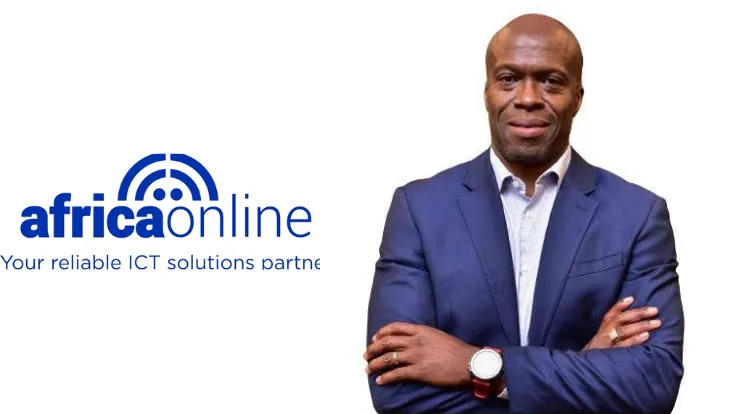
- Founded in 1994, Ayisi Makatiani, alongside Karanja Gakio and Amolo Ng’weno, created Africa Online to provide reliable internet access to businesses and consumers across Africa.
- Africa Online expanded to at least eight African countries, including Kenya, Ghana, Côte d’Ivoire, Tanzania, and Namibia, addressing connectivity gaps in enterprise and consumer sectors.
- Under Makatiani’s leadership, Africa Online became a continent‑recognised ISP, later acquired by Telkom South Africa in 2007, cementing its role in Africa’s digital development.
Lagos, Nigeria, Saturday, January 31, 2026 - In the early 1990s, Africa faced one of its most significant digital challenges. Internet connectivity was sparse, slow, and largely inaccessible to both businesses and consumers. While other regions were rapidly embracing the internet as a tool for commerce, education, and communication, African countries struggled with limited infrastructure, unreliable service providers, and a lack of local expertise.
It was at this time that Ayisi Makatiani, along with co-founders Karanja Gakio and Amolo Ng’weno, recognized an opportunity to bridge the continent’s digital divide. In 1994, they launched Africa Online, one of Africa’s first and largest Internet service providers. Unlike simple web portals or international service resellers, Africa Online focused on building robust infrastructure, reliable connectivity, and scalable internet solutions tailored to African realities.
From the outset, Africa Online sought to address structural barriers hindering digital adoption. These included limited broadband access, underdeveloped telecommunications networks, fragmented enterprise connectivity solutions, and low consumer confidence in online services. By providing internet access through dial-up, leased lines, DSL, VSAT, and VPN services, Africa Online enabled businesses to connect reliably and consumers to experience the internet for the first time.
The company’s growth was not limited to Kenya. Over the next decade, Africa Online expanded into at least eight African countries, including Ghana, Côte d’Ivoire, Tanzania, Namibia, Uganda, Zimbabwe, and Swaziland. This cross-border expansion demonstrated both the demand for connectivity across the continent and the potential for African-led tech infrastructure companies to scale beyond national boundaries.
Africa Online’s journey highlights a crucial narrative in African entrepreneurship: solving systemic problems with locally-informed solutions. Ayisi Makatiani’s leadership emphasized both innovation and operational excellence, laying the groundwork for a company that would later be recognized by international investors and acquire a lasting place in Africa’s digital ecosystem.
This article explores Ayisi Makatiani’s life, experiences, and role in Africa Online, detailing how his vision addressed critical connectivity challenges, the milestones the company achieved, and the lessons his journey provides for future African tech entrepreneurs.
Early Life, Education, and Experience
Ayisi Boniface Makatiani was born in 1966 in Kenya. Publicly available sources provide limited detail about his childhood, but it is known that he attended Maseno School and later Alliance High School, two of Kenya’s respected educational institutions for secondary education. These formative years provided a strong academic foundation that would later support his studies abroad.
Following his secondary education, Makatiani moved to the United States for higher education. He earned a Bachelor of Science degree in Electrical and Electronics Engineering from the Massachusetts Institute of Technology (MIT), where he also completed a minor in economics. While at MIT, he developed early exposure to technology and systems thinking, experiences that informed his later entrepreneurial ventures.
After completing his studies, Makatiani returned to Kenya and, in 1994, co-founded Africa Online alongside Karanja Gakio and Amolo Ng’weno. Africa Online became one of the continent’s earliest and largest Internet service providers, offering connectivity services to both businesses and consumers across multiple African countries.
Beyond Africa Online, Makatiani has held leadership roles in other organizations. He served as CEO of African Management Services Company (AMSCO), a firm backed by the International Finance Corporation (IFC), the United Nations Development Programme (UNDP), and the African Development Bank. He is also the Managing Partner and CEO of Fanisi Capital Ltd., a venture capital and private equity firm investing in East African enterprises. Additionally, he has held advisory and board roles, including as an adviser to the President of Kenya, a member of the National Economic and Social Council (NESC), and Non-Executive Director at Kenya Airways.
Makatiani’s contributions have been recognized through national honors, including the Elder of the Order of the Burning Spear (EBS) in 2010, one of Kenya’s highest civilian awards. His professional journey combines technical expertise, entrepreneurship, and leadership across both public and private sectors, providing a strong foundation for his pioneering work in Africa’s digital landscape.
Inspiration to Start Africa Online
Publicly available sources indicate that Ayisi Makatiani and his co-founders, Karanja Gakio and Amolo Ng’weno, founded Africa Online in 1994 with the goal of addressing the lack of internet access and connectivity in Africa. At the time, most African countries had extremely limited internet infrastructure, and businesses and consumers faced challenges in accessing reliable digital services.
Makatiani’s exposure to technology and systems thinking while studying Electrical and Electronics Engineering at MIT is reported to have influenced his interest in building digital infrastructure. His experiences with early networking technology, combined with the recognition of Africa’s digital gap, motivated him to create a company that could provide internet services tailored to African markets.
The company was conceived to provide affordable, reliable, and scalable connectivity to both businesses and individual users across multiple African countries. Africa Online’s founders identified the structural barriers to digital adoption, including poor telecommunications infrastructure, low access to international internet gateways, and the absence of locally-operated ISPs. The platform was designed not just to sell internet access but to build systems and services that could support enterprise and consumer needs in a fragmented digital environment.
Problems Africa Online Helps Solve
When Africa Online was founded in 1994, the continent faced major challenges in accessing reliable internet and digital communication services. Limited infrastructure, fragmented networks, and a lack of local expertise made internet adoption difficult for both businesses and consumers. Africa Online was created to address these structural gaps and enable connectivity solutions that could scale across multiple African markets.
Key problems Africa Online addressed include:
- Limited Internet Access: Many African countries had extremely low penetration of internet services in the 1990s. Africa Online provided dial-up internet and later DSL and VSAT services, making connectivity accessible to both enterprises and individual consumers.
- Weak Telecommunications Infrastructure: Existing telecom networks were often unreliable, with frequent outages and low bandwidth capacity. Africa Online offered dedicated leased lines, WAN, and VPN services to businesses, improving reliability and enabling enterprise-level digital operations.
- Fragmented Digital Markets: Across Africa, there was no unified approach to providing internet services. Africa Online expanded into multiple countries, including Kenya, Ghana, Côte d’Ivoire, Tanzania, Namibia, Uganda, Zimbabwe, and Swaziland, creating a pan-African network of connectivity solutions.
- Low Trust in Internet Services: Early internet users were often hesitant due to poor service quality and a lack of local support. Africa Online focused on locally managed infrastructure, customer support, and service reliability, helping build trust in internet adoption.
- Barriers for Enterprises: Many businesses lacked affordable and secure access to international and regional networks. Africa Online provided enterprise-focused services such as dedicated connections and virtual private networks (VPNs), enabling companies to operate efficiently online.
Through these interventions, Africa Online helped close the digital gap for both consumers and enterprises, laying the groundwork for broader internet adoption in multiple African countries. By addressing infrastructure, accessibility, and trust, the company set a precedent for locally-led internet service provision and digital entrepreneurship across the continent.
Milestones Achieved to Date
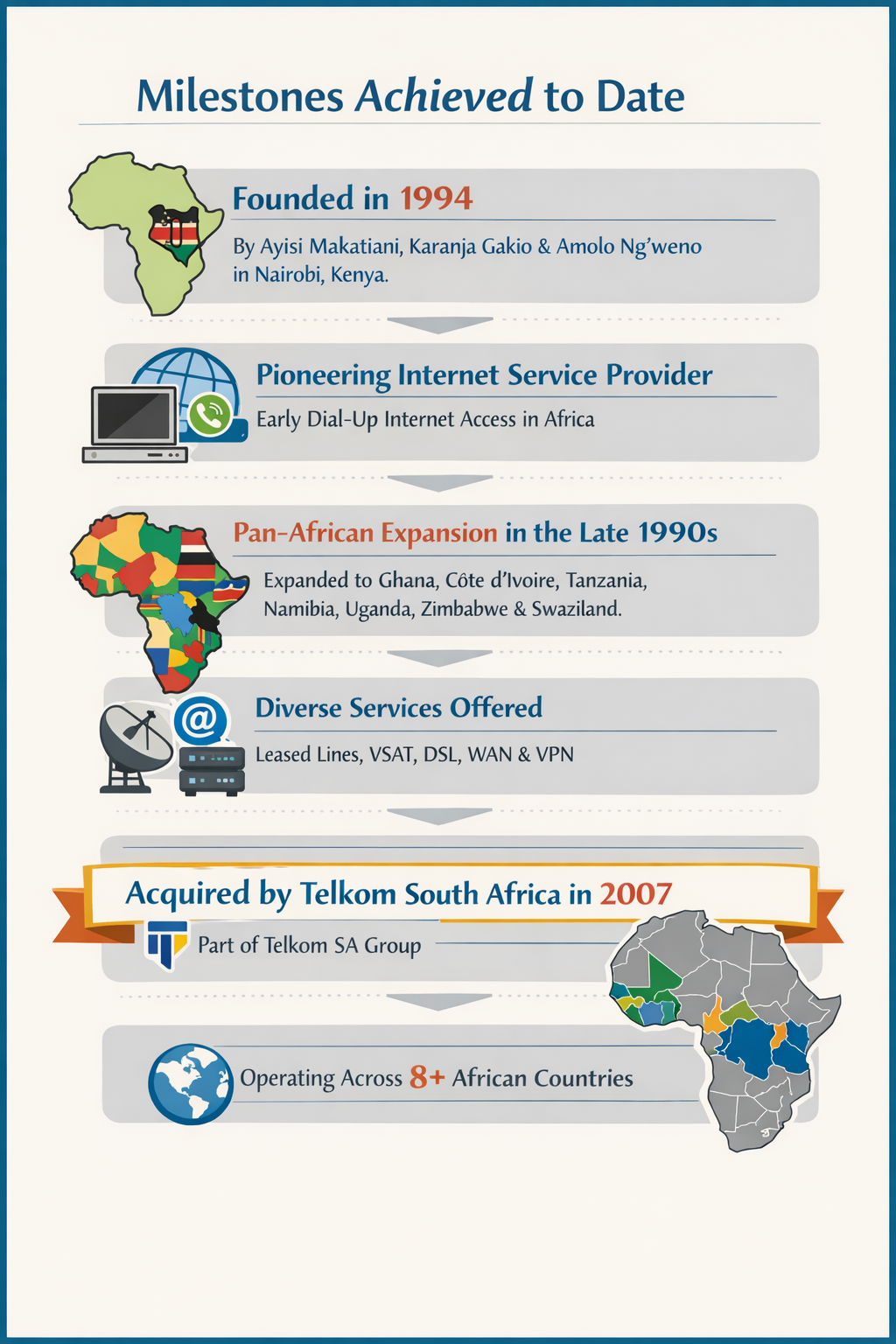
Africa Online was founded in 1994 by Ayisi Makatiani, Karanja Gakio, and Amolo Ng’weno, marking one of the earliest and most ambitious internet service ventures on the African continent. Initially based in Nairobi, Kenya, the company focused on providing dial-up internet access to both individual consumers and enterprises, filling a critical gap in connectivity at a time when internet infrastructure in Africa was extremely limited.
By the late 1990s, Africa Online had expanded its operations to multiple African countries, including Ghana, Côte d’Ivoire, Tanzania, Namibia, Uganda, Zimbabwe, and Swaziland (Eswatini). This expansion allowed the company to provide regional internet services, establishing it as one of the first pan-African Internet Service Providers. Africa Online offered a wide range of services, including leased lines, email accounts, VSAT, DSL, WAN, and VPN services, enabling businesses to operate online reliably despite the fragmented telecommunications landscape.
In 2007, Africa Online became a subsidiary of Telkom South Africa, providing the company with greater financial backing and operational support while integrating its services with a larger African telecom infrastructure. This acquisition also strengthened Africa Online’s ability to scale operations and continue offering enterprise-level solutions across the continent.
No publicly available information exists on specific revenue figures, the number of subscribers, or current employee counts as of 2026. Similarly, there are no public reports detailing exact technology upgrades or investment amounts in each country over the years. However, Africa Online’s continued operation across at least eight African nations and its acquisition by Telkom South Africa reflect its sustained influence in building African digital infrastructure and expanding access to internet services.
Lessons for Other Entrepreneurs
The journey of Ayisi Makatiani and Africa Online provides valuable lessons for entrepreneurs looking to build technology and infrastructure businesses in Africa. From founding one of the continent’s first pan-African ISPs to expanding across multiple countries, Africa Online demonstrates how identifying structural gaps and delivering locally relevant solutions can create sustainable impact.
Key lessons from Ayisi Makatiani and Africa Online include:
- Address Real Structural Gaps: Makatiani’s work highlights the importance of identifying systemic problems in this case, the lack of reliable internet infrastructure, and building solutions that directly address them, rather than pursuing trends or short-term opportunities.
- Think Regionally, Not Just Locally: Africa Online expanded beyond Kenya to at least eight African countries, showing that scaling across borders can multiply impact while creating operational resilience and regional relevance.
- Invest in Reliability and Trust: Early internet adoption in Africa faced skepticism due to poor service quality. Africa Online focused on building reliable systems and customer support, demonstrating that trust and quality are critical to sustaining digital ventures in emerging markets.
- Leverage Technical and Business Expertise: Makatiani’s combination of engineering training and economic/business knowledge enabled him to design technically robust solutions while understanding the broader market and commercial needs, underscoring the value of multi-disciplinary skills for tech entrepreneurs.
- Partnerships Can Accelerate Growth: The acquisition by Telkom South Africa in 2007 illustrates how strategic partnerships or corporate backing can help scale operations, expand infrastructure, and strengthen market presence without losing the founding vision.
Overall, the Africa Online story under Ayisi Makatiani demonstrates that entrepreneurs who solve systemic challenges, build trust, and combine technical expertise with strategic partnerships can achieve sustainable impact in emerging markets, particularly in sectors where infrastructure gaps exist.
Ayisi Makatiani’s leadership at Africa Online highlights how addressing structural gaps in connectivity can create a lasting impact across multiple African markets. Since its founding in 1994, the company has expanded internet access to businesses and consumers in at least eight countries, laying a foundation for digital adoption on the continent. Now part of Telkom South Africa, Africa Online continues to operate within a telecom landscape that is entering a growth phase, with increasing investment in broadband, fiber networks, and digital services. While the company’s specific plans for 2026 are not publicly disclosed, its historic focus on reliable, locally-informed connectivity positions it to benefit from broader continental trends in digital inclusion, enterprise adoption, and infrastructure expansion, reinforcing its role in supporting Africa’s evolving digital economy.