Over the past decade, Ethiopia's telecom sector focused heavily on adding new subscribers. Now, the country has crossed a structural threshold whereby voice penetration or subscriber addition is no longer the binding constraint on sector growth.
Ethiopia's telecom market now faces a tougher challenge in the next phase. In this new phase, monetising data, scaling digital payments, and sharing passive infrastructure matter more than raw SIM distribution. The financial reports of the two licensed operators (Ethio Telecom and Safaricom Ethiopia), and the current policy debates in Addis Ababa, clearly highlight this looming change. Investors, policymakers, and operators no longer ask how many Ethiopians will buy a phone. Instead, they ask how much economic value each connected citizen can create, and what infrastructure will support that activity.
Has Ethiopia's subscriber story already matured?
The headline numbers confirm this rapid growth. The World Bank reports that mobile subscriptions surged by 98 percent over six years, climbing from 44.2 million in 2018 to 87.6 million in 2024. Ethio telecom itself reported passing the 87 million subscriber mark during the first half of the 2025/26 fiscal year. Safaricom Ethiopia, the market's second operator, announced 13.6 million active users over a 90-day period in its FY26 results. The company also secured 5.2 million M-PESA customers and operates 3,504 network sites. Of these network sites, the company has built 2,076 from scratch and leased 1,428 on shared infrastructure.
Telecom companies now find it harder to win new subscribers, and each new user adds less value than a new gigabyte of data sold or a new mobile wallet transaction. While subscriber numbers continue to grow, they no longer drive the majority of profits. Companies that still base their strategies on traditional voice revenues will watch their profit margins shrink. In contrast, operators that focus on data, digital payments, and shared infrastructure will capture the industry's next wave of financial growth. Current revenue numbers support this trend. Ethio telecom achieved a 72.9 percent revenue growth in 2024/25, far outpacing its single-digit subscriber growth. Data sales, digital payments, and enterprise services made up that difference anchored on its telebirr platform.
Where is the new value pool forming?
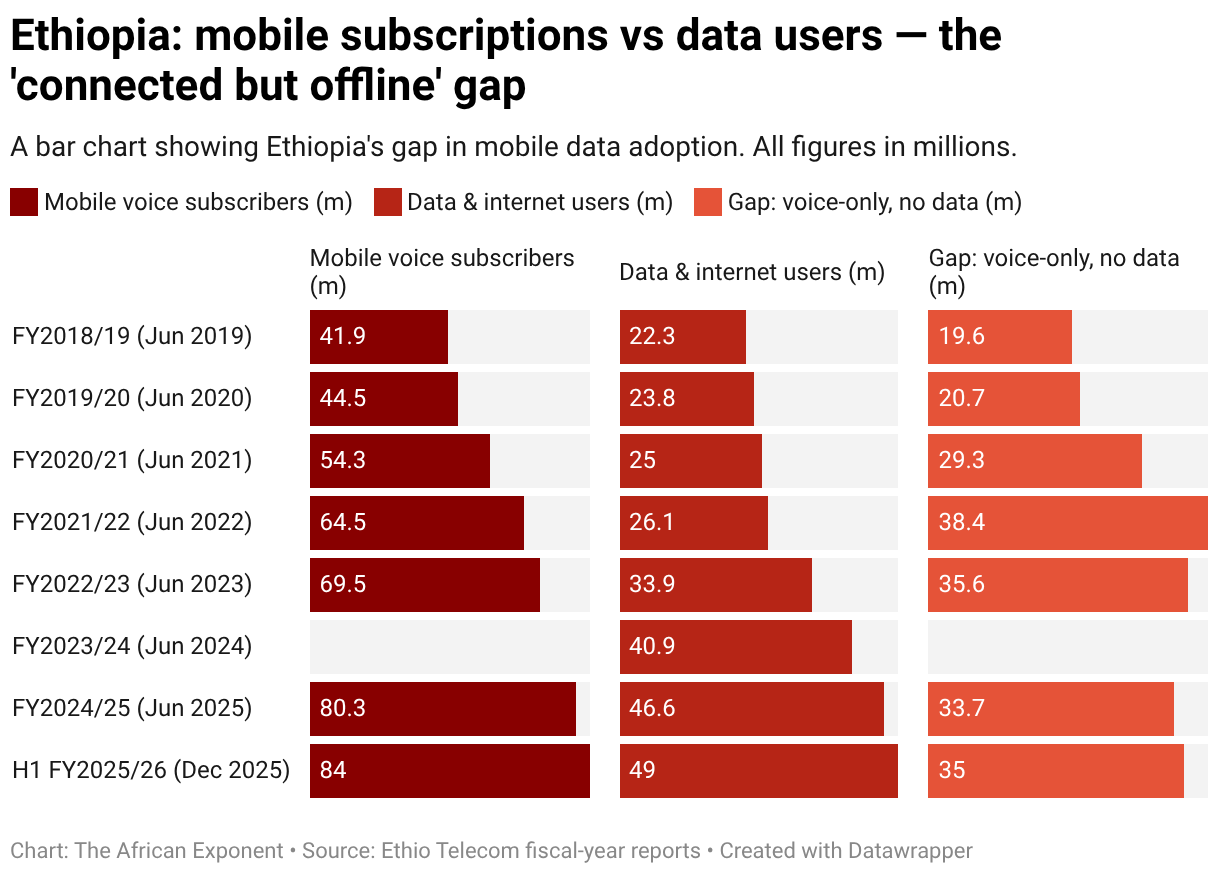
Three new revenue pools are forming for telecom companies. The first is mobile data. The World Bank counted 87.6 million mobile subscriptions in 2024, but only 54.1 million unique mobile broadband users, representing just 41 percent of the population. Ethio telecom's own network data highlights the same trend. In the first half of the 2025/26 fiscal year, the company reported 84 million voice users but only 49 million data users. The number of Ethiopians who own a SIM but never use mobile data has stayed near or above 30 million for five straight years — 19.6 million in 2019, peaking at 38.4 million in 2022, and still roughly 35 million today. Operators can unlock immediate revenue by moving these users from basic 2G phones to 4G smartphones and upgrading them to higher data plans. The potential growth is massive, especially since the World Bank notes that over 40 million Ethiopians still lack 4G coverage entirely.
The second pool is digital payments. Ethio telecom's telebirr platform now boasts over 54.8 million accounts. The company disclosed that the platform processed over Birr 6.8 trillion in total transactions between its 2021 launch and the first half of 2025/26. Safaricom Ethiopia's M-PESA platform holds a smaller base of 5.2 million customers, but this number more than doubled during FY26. Safaricom drives this growth through an aggressive push to sign up merchants and a network that covers 59 percent of the population with 4G. Mobile money now serves as the foundation for everyday household and small business commerce in Ethiopia. The National Bank of Ethiopia counts over 136 million registered mobile money users who generate 9.6 trillion Birr in annual digital transactions.
The third pool is enterprise connectivity. Banks, logistics companies, manufacturers, and government agencies are rapidly digitising their operations. As a result, they demand reliable fiber-optic connections, secure VPNs, data center access, and cloud services at a pace that exceeds everyday consumer data growth. Telecom operators who build high-quality business networks and lease out fiber and tower space will secure steady, long-term contracts. This strategy protects their revenue from the fierce price wars happening in the consumer voice and data markets.
How big is the infrastructure gap?
The World Bank estimates that Ethiopia needs between 10,000 and 15,000 new towers to match its regional neighbours. The country also requires at least 15,000 new 4G or 5G radio sites and a much larger national fiber network. Right now, the physical infrastructure falls short of what the population demands. However, this shortfall does not point to operator failure. Instead, it highlights massive room for growth. As subscriber numbers have peaked, companies have not yet built the physical networks and passive infrastructure they need to boost coverage, improve service quality, and handle the upcoming surge in data traffic.
The industry also vastly underuses the assets it already has. The World Bank notes that Ethiopia possesses about 138,000 utility poles, but telecom networks currently use only 7 percent of them. This represents a policy and business failure rather than a technical barrier. Telecom operators and other sectors like power and transport need to share physical infrastructure, including towers, poles, ducts, and fiber lines. Sharing these resources would slash the costs of building new networks and eliminate wasteful duplication. Most importantly, cooperation would help operators reach rural communities that no single company can afford to connect on its own.
Fortunately, government policies show positive momentum. In January 2026, the Ethiopian Communications Authority ordered Ethio telecom to lower the infrastructure-sharing fees it charges Safaricom Ethiopia, updating the terms from their 2022 agreement. The regulator also told the companies to settle most of these payments in local birr. This ruling affects the towers and physical facilities that support more than half of Safaricom's network. In its FY26 results, Safaricom Ethiopia disclosed USD 2.65 billion in total funding. The company built its financial model entirely around leasing and sharing infrastructure, treating co-location as a core strategy rather than an afterthought. Currently, Safaricom co-locates two out of every five sites rather than building its own. Even so, the CEO estimates the company will need another USD 5 billion to achieve full nationwide coverage.
Looking ahead, the market awaits the next major regulatory milestone. Regulators must create a formal rulebook for sharing towers and poles, set clear access prices, and design a solid dispute resolution process. If they fail to do this, the infrastructure gap will hold back data revenues instead of serving as a lucrative opportunity for investors.
What does this mean for investors and operators?
The investment horizon in Ethiopia's telecom sector is changing. Selling basic voice services now offers low profit margins in a crowded market. Today, the real growth happens further up the value chain. Companies find new profits in building towers, laying fiber networks, connecting businesses, financing devices, processing merchant payments, and forming rural partnerships. These new areas reward operators and investors who use their capital and patience to build shared infrastructure instead of simply chasing higher subscriber counts.
Operators must prioritise building business-to-business services and shared infrastructure before fierce retail competition shrinks their revenue per user. Ethiopia's telecom market already proved it can rapidly attract new subscribers. Now, the industry must generate revenue, share resources, and build physical networks all at once. Operators and financial backers will capture this next wave of value only if they treat Ethiopia as a market for infrastructure and revenue growth, rather than just a race for new users.