In Summary
- Presidential Proclamation 10563, expanded in December 2025, governs the latest travel restrictions.
- Full visa suspensions apply to 12 African countries, while partial restrictions target at least nine others.
- Data from the U.S. Department of Homeland Security (DHS), consular reports, and interagency assessments inform these decisions.
- Restrictions include visa validity reductions, single-entry limitations, increased documentation, and, in some cases, suspension of new visa issuance.
Understanding U.S. Travel Restrictions
The U.S. travel restrictions affecting several African countries in 2026 are based on Presidential Proclamation 10563, first issued in 2017 and expanded in December 2025. This legal framework allows the U.S. government to limit entry from countries whose nationals cannot be reliably screened, verified, or monitored for immigration compliance. The 2025 expansion specifically targeted African nations with high visa overstay rates, limited administrative capacity, or inadequate cooperation on security and identity data sharing (U.S. State Department, 2025).
Countries are evaluated against three main criteria:
- Identity Verification: Nations with incomplete civil registries, inconsistent passport issuance, or limited biometric systems are flagged.
- Visa Overstay Rates: DHS monitors overstays across all visa categories. Countries exceeding approximately 5% are considered high risk (DHS, 2024–2025).
- Data-Sharing Capacity: Delayed or incomplete sharing of criminal, civil, or identity information with U.S. authorities can lead to restrictions.
Security concerns are also considered, particularly where administrative oversight is insufficient to prevent entry by individuals linked to extremist or criminal networks.
The U.S. applies a structured review mechanism to ensure restrictions are measured and consistent. Each year, the State Department and DHS conduct assessments using both quantitative and qualitative metrics. Interagency panels, including representatives from State, DHS, Justice, and intelligence agencies, review overstay rates, passport reliability, biometric coverage, and security incidents. Countries receive detailed reports highlighting specific gaps in verification or administration. Recommendations are submitted to the Secretary of State, who decides whether to impose, maintain, or lift restrictions. Continuous monitoring allows mid-cycle reassessments if a country demonstrates administrative or compliance improvements. U.S. embassies often provide guidance and technical support to assist governments in meeting required benchmarks.
Sample DHS Overstay Data (2024–2025)
By grounding restrictions in measurable administrative and security factors, Proclamation 10563 ensures U.S. policies are data-driven, transparent, and responsive. It also provides a roadmap for affected countries: improvements in identity verification, registry systems, and overstay compliance can lead to eased restrictions in future assessments.
Deep Dive: Why Restrictions Occurred
January 18th, 2026- For decades, travel from Africa to the United States has been regulated but largely accessible through standard visa channels. While approval rates varied and scrutiny was often intense, most African nationals could still apply for tourist, student, business, or family visas. That reality has shifted sharply.
In December 2025, the U.S. government expanded a presidential proclamation restricting entry from countries deemed unable to meet certain screening, identity verification, and security information standards. The measures came into force on January 1, 2026, reshaping mobility for millions of Africans. The policy relies on data from U.S. immigration agencies, visa overstay statistics published by the Department of Homeland Security, and assessments of whether governments can reliably share criminal and identity records.
What follows is a country-by-country explanation of how these restrictions emerged, what they mean in practice, and why each nation appears on the list.
Countries Under Full U.S. Travel Suspension
Burkina Faso, Chad, Congo, Equatorial Guinea, Eritrea, Libya, Mali, Niger, Sierra Leone, Somalia, South Sudan, Sudan
Suspensions result from conflict, administrative weaknesses, and inadequate identity verification. Common challenges include disrupted passport issuance, incomplete civil registries, fragmented population records, and limited biometric ID systems. U.S. authorities cite verification difficulties, security concerns, and insufficient data-sharing as primary reasons for suspension.
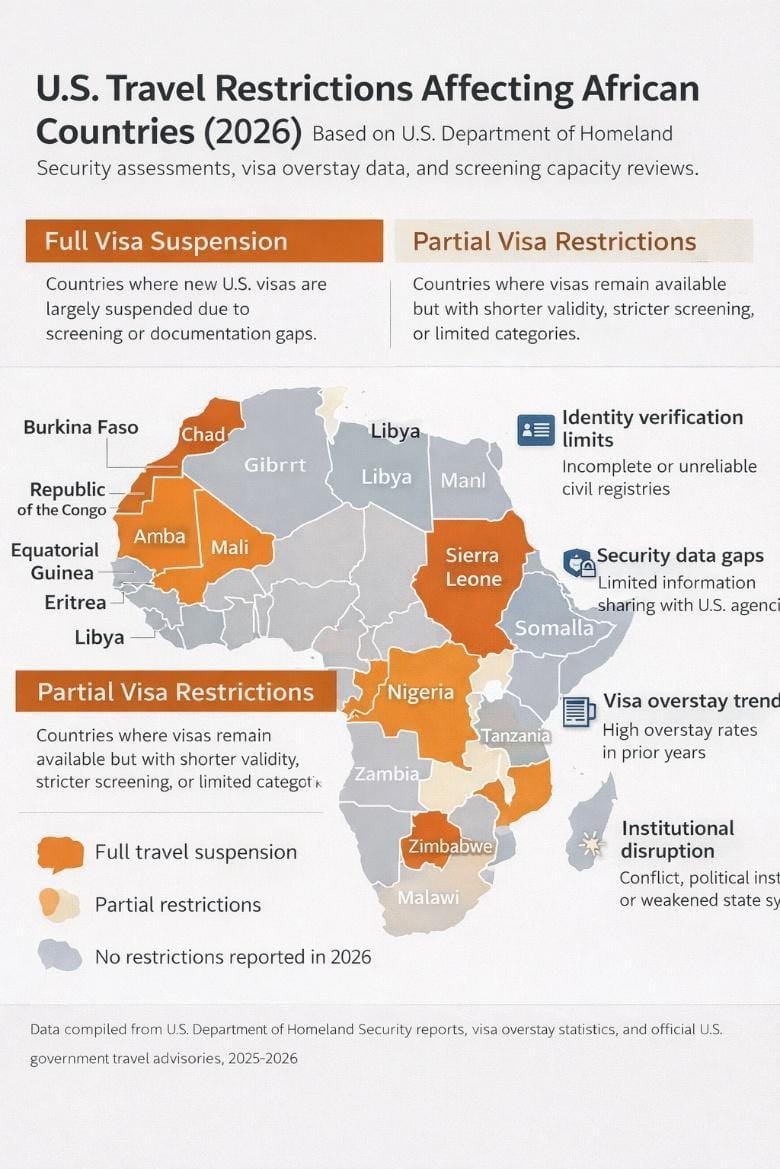
Infographic illustrating African nations whose citizens face travel restrictions to the United States in 2026, highlighting policy and regulatory trends.
Countries Under Full U.S. Travel Suspension
Burkina Faso
Burkina Faso’s inclusion reflects a convergence of security and administrative concerns. Since the mid-2010s, the country has faced an escalating insurgency linked to armed extremist groups, particularly in its northern and eastern regions. As violence intensified, state capacity weakened, including systems responsible for issuing passports and maintaining population records. U.S. authorities cite difficulties in verifying traveler identities and limited data exchange as key reasons for suspending new visa issuance. By 2026, these concerns had not been resolved, resulting in a full halt on most new U.S. visas for Burkinabé citizens.
Chad
Chad has long been a strategic security partner in the Sahel, yet its travel restrictions stem from internal structural challenges rather than diplomatic relations. High historical visa overstays rates among Chadian nationals, combined with limited biometric and civil registry infrastructure, placed the country under scrutiny. Although Chad has made efforts to modernize its identification systems, U.S. assessments indicate gaps remain. As of 2026, citizens without pre-existing valid visas are unable to obtain new U.S. entry clearance.
Congo
The Republic of the Congo’s restrictions are rooted in governance and documentation challenges rather than conflict. U.S. authorities point to inconsistent passport issuance standards and insufficient real-time information sharing. While the country maintains political stability relative to some neighbors, weaknesses in administrative transparency have hindered compliance with U.S. screening benchmarks, prompting a suspension of new visas in most categories.
Equatorial Guinea
Equatorial Guinea’s case reflects the paradox of wealth without institutional depth. Despite oil revenues, the country has lagged in developing robust civil documentation systems. U.S. reviews highlight concerns around identity verification and limited cooperation on security data. These issues, rather than migration volume, underpin the 2026 travel suspension affecting new visa applicants.
Eritrea
Eritrea has faced U.S. travel restrictions for several years, and its 2026 status reflects long-standing isolation. Mandatory national service, limited freedom of movement, and opaque state records complicate vetting processes. U.S. authorities maintain that the absence of reliable civil registries and constrained diplomatic engagement makes effective screening difficult, leading to continued restrictions.
Libya
Libya’s restrictions are closely tied to prolonged conflict and fragmented governance since 2011. With competing administrations and disrupted state institutions, passport issuance and identity verification remain inconsistent. Even though some regions have stabilized, U.S. policy treats Libya as a high-risk environment for screening failures. As of 2026, most Libyan citizens cannot obtain new U.S. visas unless covered by narrow exemptions.
Mali
Mali’s inclusion reflects the broader destabilization of the central Sahel. Following repeated coups, rising insurgency, and the withdrawal of international peacekeeping forces, Mali’s administrative capacity deteriorated. U.S. evaluations emphasize the difficulty of verifying background information and the absence of dependable security cooperation, leading to a suspension of visa issuance.
Niger
Niger’s position mirrors Mali’s, though its inclusion surprised some observers given its prior cooperation with Western partners. Political upheaval, including the 2023 coup, disrupted governance systems and data-sharing mechanisms. By 2026, U.S. assessments concluded that screening standards were no longer met, resulting in full travel restrictions.
Sierra Leone
Unlike conflict-driven cases, Sierra Leone’s restriction is tied primarily to visa compliance history. U.S. immigration data consistently showed high overstay rates among Sierra Leonean visitors. Despite improvements in governance since the end of its civil war, overstays and documentation concerns led to suspension under the 2026 policy.
Somalia
Somalia’s restrictions are among the longest-standing. Decades of state collapse, followed by gradual reconstruction, left gaps in civil registration and border control. Although progress has been made through biometric ID programs, U.S. authorities maintain that verification remains insufficient for reliable screening, justifying continued restrictions.
South Sudan
As the world’s youngest country, South Sudan has struggled to build basic administrative systems amid recurring conflict. Passport issuance, population records, and background checks remain fragmented. These structural weaknesses, rather than migration volume, explain the U.S. decision to maintain a full visa suspension in 2026.
Sudan
Sudan’s recent history of political upheaval and armed conflict has severely disrupted state institutions. Civil registries, immigration offices, and border systems have been damaged or rendered inoperable. U.S. assessments highlight these disruptions as central to the decision to restrict travel, even as humanitarian exceptions remain limited.
Countries Under Partial U.S. Travel Restrictions
For another group of African countries, the U.S. has opted for tightened visa conditions rather than outright bans. Citizens may still apply, but face shorter visa validity, additional documentation requirements, or limited visa categories.
Nigeria
Nigeria remains Africa’s most populous nation and one of the largest sources of U.S. visa applicants. Restrictions here stem mainly from visa overstay data rather than security breakdowns. U.S. authorities have reduced visa validity periods and intensified scrutiny, particularly for tourist and business visas, while student and professional visas remain accessible under stricter review.
In Ghana, Senegal, and Côte d’Ivoire, in these West African economies, restrictions reflect overstay trends and rising application volumes. U.S. consular practices now emphasize shorter visa durations and more frequent renewals, increasing the cost and uncertainty of travel without fully blocking access.
Tanzania, Zambia, Zimbabwe, Malawi, and Angola in Southern and Eastern Africa, partial restrictions are tied to compliance metrics and documentation standards. Applicants may receive single-entry visas or reduced validity, reflecting a cautious approach rather than a punitive ban.
How Affected African Governments Are Reacting
African governments are taking a multi-pronged approach to address U.S. travel restrictions, combining administrative reforms, policy adjustments, and diplomatic engagement to restore visa access for their citizens. In Nigeria, the government has accelerated biometric passport coverage, strengthened population registration systems, and implemented more robust monitoring of visa overstays. The Ministry of Foreign Affairs is coordinating closely with U.S. consular officials to ensure that applicants meet updated verification standards, particularly for tourist and business visas, which remain under heightened scrutiny.
In Sierra Leone, authorities are modernizing passport issuance procedures, introducing digital records for civil registries, and actively tracking visa compliance to reduce overstay rates, which were reported at 7.2% in 2025. Ghana has taken similar steps, reviewing internal visa application procedures and ensuring timely communication between immigration offices and the Ministry of Foreign Affairs. Technical support from international partners is being leveraged to improve data management and document verification processes.
Smaller states, including Chad, Burkina Faso, and Eritrea, face more significant challenges due to limited infrastructure and, in some cases, conflict-affected regions. In Chad, officials are focusing on expanding biometric passport issuance and strengthening civil registry coverage, while in Eritrea, the government is exploring measures to improve identity verification systems despite long-standing diplomatic isolation. Burkina Faso is rebuilding administrative capacity in areas previously affected by insurgency, aiming to ensure passport issuance and registry systems meet international standards.
Several countries are also engaging regionally. West African nations are collaborating through ECOWAS initiatives to share identity verification data, improve border management, and standardize documentation procedures. Technical partnerships with international agencies are helping governments upgrade biometric systems, train staff, and implement overstay monitoring programs.
Overall, these efforts demonstrate a clear recognition across Africa that travel restrictions are closely tied to administrative capacity, compliance, and security vetting. Governments are pursuing a combination of technical reforms, diplomatic outreach, and regional cooperation to gradually restore normal visa access, reduce overstay rates, and meet the verification and data-sharing expectations of U.S. authorities.
Who is exempt?
- Diplomats, staff of international organizations, and pre-approved visa holders remain exempt.
- Exemptions exist because these groups undergo rigorous vetting and are considered low-risk for overstays or security breaches.
Are students affected?
- Students can still apply for visas, but approvals may be under tighter scrutiny, with shorter validity periods and additional documentation.
- U.S. universities provide letters of enrollment to facilitate processing. STEM, research, and professional programs often receive special attention to minimize disruption.
Can restrictions be lifted?
Yes. The U.S. conducts annual assessments. Countries that demonstrate improvements in civil registry integrity, biometric ID coverage, overstay reduction, and data-sharing capacity can have restrictions eased or removed. Mid-cycle reassessment is possible if measurable administrative or compliance progress is documented. Countries are encouraged to engage with U.S. diplomatic channels and implement technical reforms, such as biometric passports or population registry modernization, to restore normal visa processing.
Conclusion
U.S. travel restrictions underscore the connection between governance, administrative capacity, and historical visa compliance. High overstay rates (typically above 5%) combined with weak documentation systems are consistently flagged for full suspension. Partial restrictions serve as cautionary measures, maintaining access while incentivizing administrative improvements.
By 2026, these measures reflect a shift toward selective, data-driven mobility policies, where individual access is closely tied to national administrative performance and governance standards. African governments must continue investing in secure identification, population management, and intergovernmental cooperation to expand access for their citizens.

