Table of Contents
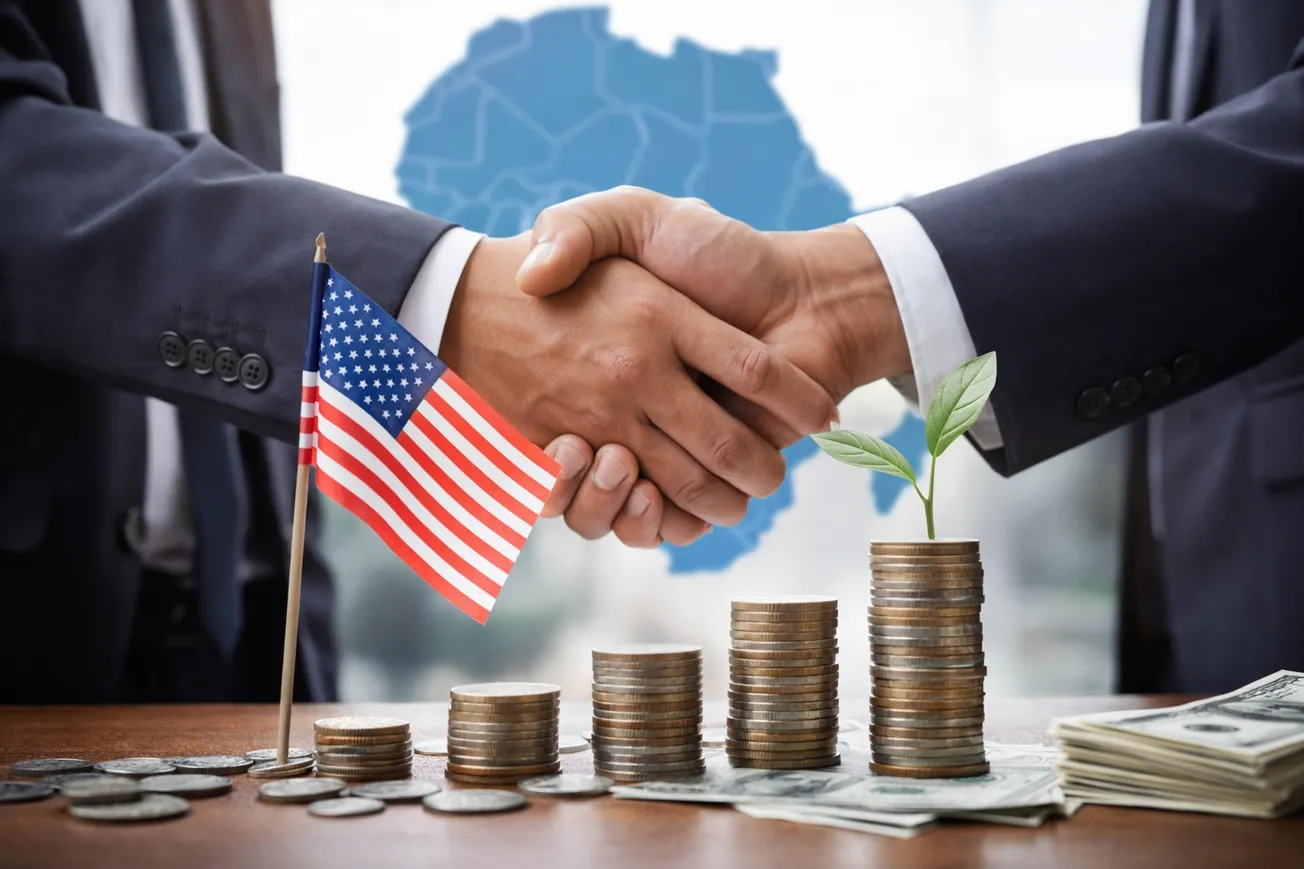
The United States’ strategic approach to African infrastructure has intensified under the Partnership for Global Infrastructure and Investment (PGI) and complementary programs such as Power Africa and the U.S.-Africa Investment Initiative. These projects are not isolated developments but part of a broader effort to support trade, energy security, and regional integration. U.S. engagement combines long-term private equity, technical assistance, and risk mitigation mechanisms, enabling projects that might otherwise remain financially or operationally unviable.
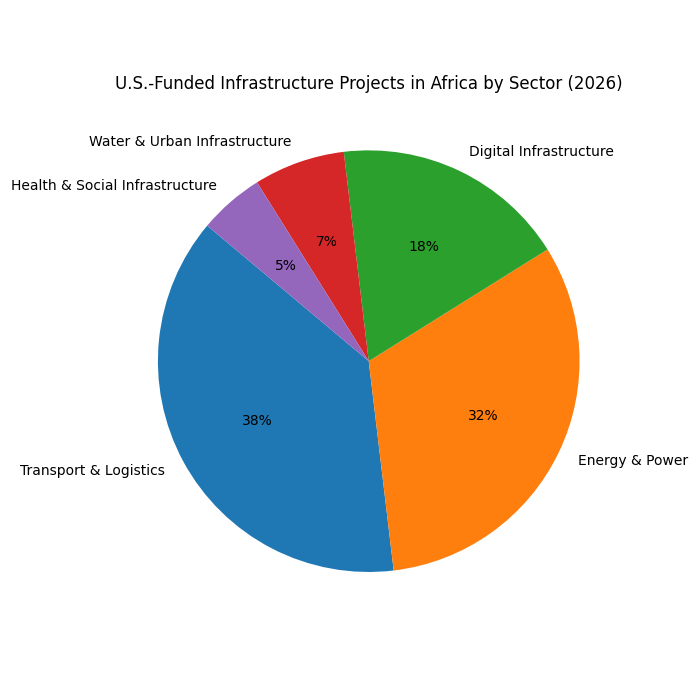
How U.S.-funded infrastructure projects in Africa (2026) are distributed by sector, based on publicly disclosed PGI, DFC, and Power Africa project pipelines.
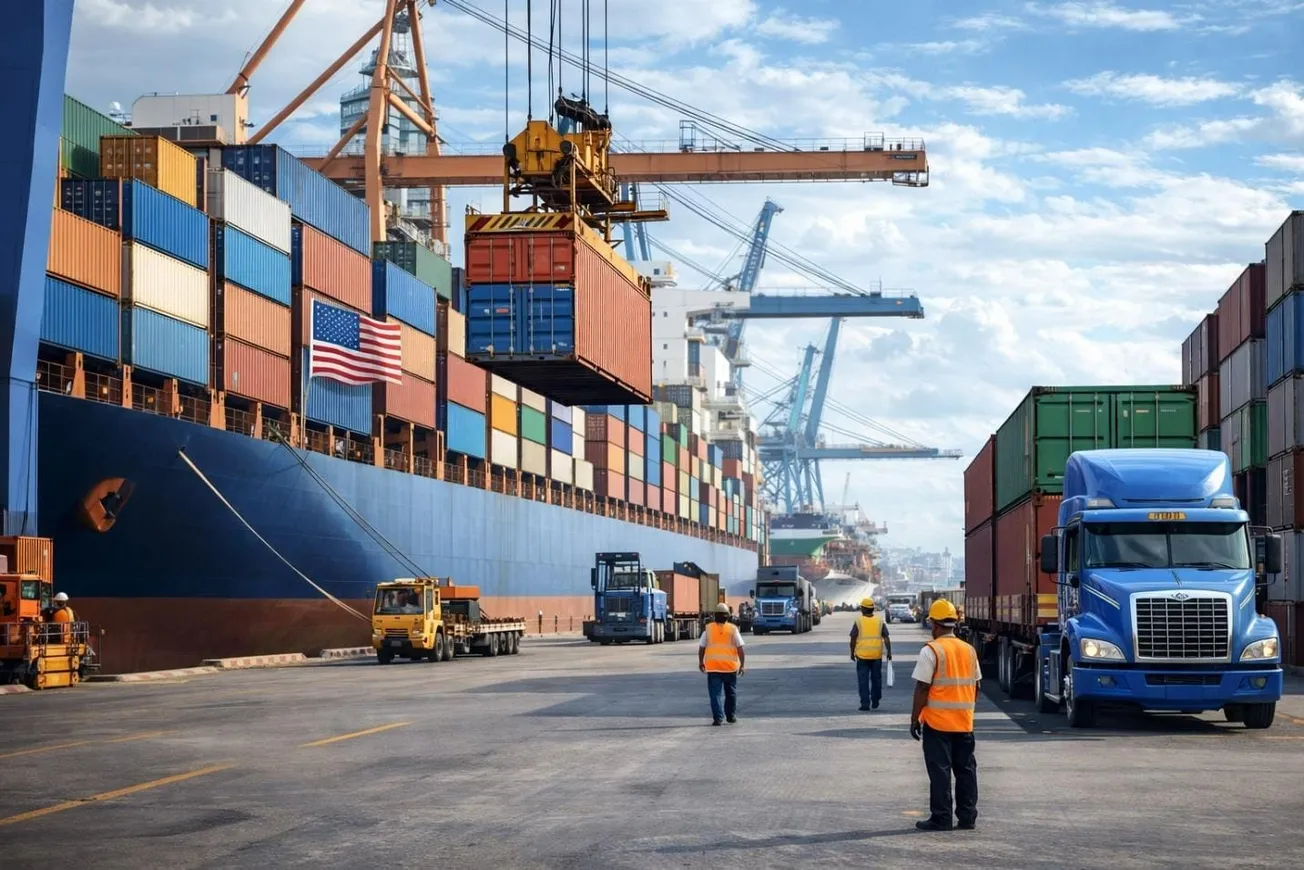
Infrastructure investment is concentrated in sectors that create multiplier effects across the economy. Transport corridors reduce logistics costs and unlock mining, agriculture, and industrial potential. Renewable and traditional energy projects secure reliable power for industrialization, while digital infrastructure investments expand connectivity for commerce, finance, and governance. By targeting high-impact nodes across Africa, U.S. infrastructure finance aims to foster both economic growth and strategic partnerships, ensuring sustainable and resilient regional networks.
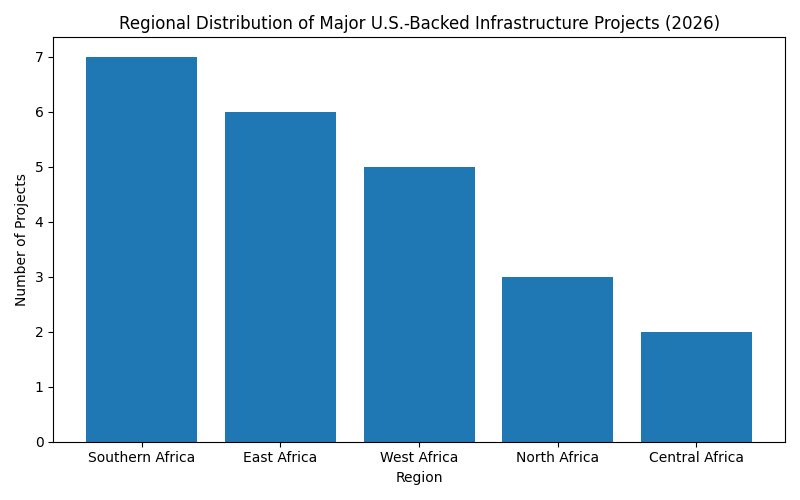
Southern and East Africa host the largest concentration of U.S.-supported infrastructure projects, driven by mineral corridors, energy interconnectors, and export logistics.
10. Egypt: Transport, Ports, and Energy Infrastructure Platforms
Egypt’s infrastructure footprint supported by U.S. capital is diverse, reflecting its role as North Africa’s largest economy and its strategic position as a continental transport and logistics hub. While not a single “mega-project,” cumulative U.S. engagement across ports, logistics facilities, and energy infrastructure has significantly enhanced Egypt’s connectivity and export platforms.
Over the past decade, American multinationals and U.S. financing institutions have deepened their presence in Egypt’s energy and transport sectors, participating in upgrading container terminals, strengthening port logistics at Alexandria and East Port Said, and supporting natural gas infrastructure that underpins industrial zones. According to UNCTAD’s World Investment Report and U.S. development finance disclosures, Egypt received tens of billions of dollars in FDI in 2024–2025 with a notable share tied to strategic projects involving U.S. private equity and institutional capital. Incorporating U.S. capital into these platforms aligns with broader national reforms aimed at liberalizing foreign ownership rules, strengthening export processing zones, and boosting non-oil exports to Europe and the United States. While Egypt’s project portfolio spans multiple sectors, the cumulative effect is a multi-billion-dollar infrastructure ecosystem that undergirds regional trade and supports the country’s role as a gateway between Africa, the Middle East, and Europe.
U.S. involvement in Egypt’s infrastructure is driven by long-term commercial opportunity and geopolitical considerations. Investors benefit from Egypt’s large domestic market of over 110 million people, improving macroeconomic stability following IMF-supported reforms, and strategic location at the entrance to the Suez Canal, historically one of the world’s busiest maritime routes. Continued engagement is expected as U.S. interests in expanding trade ties, security cooperation, and energy partnerships intensify through 2026.
9. Democratic Republic of the Congo: Mining-Linked Transport and Power Support Infrastructure
In the Democratic Republic of the Congo (DRC), U.S. infrastructure investment is anchored around transport and power projects that underpin critical mineral supply chains needed for electric vehicles, renewable energy, and high-tech manufacturing. The DRC is estimated to host some of the world’s richest copper and cobalt deposits ,metals central to the global clean energy transition which has drawn the strategic attention of U.S. policymakers and investors keen to diversify supply routes and reduce dependence on single points of global leverage.
U.S. involvement in the DRC focuses on supporting road rehabilitation linking mining regions to key rail and port infrastructure, and on power transmission upgrades that help mining zones maintain reliable electricity supply. Through partnerships with the U.S. International Development Finance Corporation (DFC) and technical assistance from the U.S. Trade and Development Agency (USTDA), feasibility studies and preparatory work have been funded to enhance the bankability of these transport and energy linkages. These efforts are partly aimed at integrating the DRC’s transport network with broader regional corridors such as the Lobito Trans-Africa Corridor (see No. 1 below), which would enhance export capacity for minerals while supporting economic growth and employment in local communities.
The strategic impetus for U.S. investment in the DRC’s transport and power infrastructure arises from global competition over critical minerals and the need to build supply chains that are resilient, transparent, and diversified. As global electrification accelerates, strong infrastructure in the heart of Africa’s mining belt enables the DRC to claim a more substantial share of added value in commodity export markets rather than remaining solely a raw material exporter.
8. Morocco: Renewable Energy and Industrial-Linked Rail Infrastructure
Morocco’s infrastructure draw for U.S. investors in 2026 stems from its ambitious renewable energy programs and transport links that connect industrial zones to global markets. While Morocco’s project base receives significant European capital, U.S. financing institutions such as DFC and private U.S. energy firms are participating alongside local partners in solar, wind, and hybrid energy facilities. These investments support the country’s green energy transition strategy, which targets net renewable generation of over 40 percent by 2030, and strengthen Morocco’s position as a regional energy exporter.
Transport and logistics are also central to U.S. engagement. Morocco’s rail infrastructure, including connections between Casablanca, Tangier, and interior industrial hubs, receives U.S. technical and financial support through private equity and institutional commitments that aim to boost cargo capacity and facilitate exports. Morocco’s proximity to European markets gives U.S. investors an additional competitive edge, enabling them to leverage trade agreements like the U.S.-Morocco Free Trade Agreement to deepen bilateral commerce.
U.S. interest in Morocco’s infrastructure is driven by its stable investment climate, robust regulatory frameworks, and strategic geo-economic positioning bridging Africa and Europe. These factors combine to make Morocco a relatively lower-risk but high-impact arena for U.S. energy and logistics capital.
7. Ghana: Port, Energy, and Trade Facilitation Investments
Ghana’s inclusion in the U.S. infrastructure spotlight for 2026 reflects its progressive economic governance reforms and strategic positioning as a West African trade hub. Through programs administered by the Millennium Challenge Corporation (MCC) and complementary investments by DFC, U.S. capital has flowed into port upgrades at Tema, power sector stabilization, and trade facilitation infrastructure. The MCC’s last compact with Ghana included multimillion-dollar investments in port efficiency, improved customs processing, and grid resilience initiatives that help anchor broader commercial flows.
In the energy sector, American energy firms and development finance support have contributed to gas-to-power integration projects, which have incrementally reduced outages and boosted industrial reliability. Ghana’s expanding middle class and integration into global cocoa, gold, and oil markets position it as an attractive destination for U.S. infrastructure capital that targets sectors with clear revenue streams.
Strategically, U.S. engagement in Ghana advances both American commercial interests and capacity building by demonstrating how regulatory reforms and transparent procurement can unlock large infrastructure projects. Strong diplomatic and trade relations between Accra and Washington further reinforce these financing trends, making Ghana a key example of sustainable infrastructure investment in West Africa.
6. Ethiopia: Power Transmission and Industrial Corridor Infrastructure
In Ethiopia, U.S. infrastructure involvement prioritizes power transmission enhancements, industrial park electrification, and logistics support for export manufacturing. American technical assistance and partial financing have focused on increasing the reliability of electricity grids that serve critical industrial zones such as Hawassa and Kombolcha, which host major export-oriented manufacturing facilities. Through USAID’s Power Africa initiative and complementary DFC engagement, U.S. actors have supported feasibility studies and capacity building to improve transmission efficiency and reduce load shedding, a major constraint on industrial growth.
Ethiopia’s infrastructure focus aligns with its broader Homegrown Economic Reform Agenda, which emphasizes export diversification and industrialization. U.S. firms and financiers see long-term potential in supporting Ethiopia’s transition from agrarian to industrial export activities, particularly as the country develops its road and rail logistics to connect manufacturing hubs with ports in Djibouti. Although China remains a dominant investor in Ethiopia’s large-scale generation and transport projects, U.S. capital has carved a niche in power reliability and industrial support services, which are crucial precursors to attracting broader private investment.
Strategically, U.S. infrastructure engagement in Ethiopia is part of a longer-term vision that links energy reliability to export competitiveness, positioning the country to take advantage of regional trade agreements and continent-wide integration initiatives.
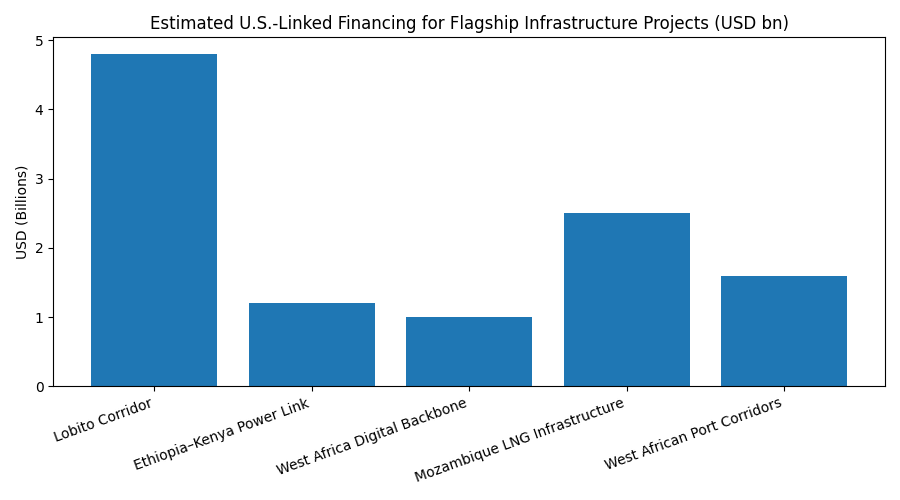
The Lobito Corridor and energy-linked infrastructure dominate U.S. infrastructure financing by value, underscoring Washington’s focus on mineral security and trade-enabling corridors.
5. Kenya: Digital and Transport Infrastructure Platforms
Kenya’s infrastructure landscape has become a focal point for U.S. involvement in digital connectivity, smart transport links, and logistics platform development. Through the U.S. Trade and Development Agency (USTDA), feasibility studies and technical assistance grants have been awarded to assess the expansion of fiber optic networks and high-capacity broadband connectivity across key urban and rural corridors. These efforts support Kenya’s ambitions to become a regional digital hub and complement private sector participation in cloud infrastructure, satellite internet testing, and data centres. American technology firms and telecom providers have also signed partnerships aimed at deploying next-generation communication technologies, fostering a business climate conducive to digital transformation.
In transport, while large power and highway projects attract diverse international financiers, U.S. infrastructure interest often focuses on smart logistics systems and digital trade facilitation, integrating Kenya’s port of Mombasa with inland corridors and customs systems. This enhances efficiency for cross-border commerce throughout East Africa. The combination of digital and physical infrastructure positioning Kenya as a gateway for both e-commerce and physical goods aligns with U.S. commercial interests in expanding connectivity and market access across the region.
Strategically, U.S. investment in Kenya’s infrastructure reflects an understanding that digital platforms are becoming as fundamental to economic growth as physical roads and rails, especially for trade, finance, and services.
4.Nigeria: Power Transmission and Gas-to-Power Infrastructure
Nigeria’s energy infrastructure has been a longstanding priority for U.S. development engagements, particularly through Power Africa, a U.S. government initiative launched in 2013. This program aims to unlock investment in electricity generation, transmission, and distribution across Sub-Saharan Africa, with Nigeria consistently ranking among the largest recipients of U.S. technical support and transaction structuring assistance.
In recent years, U.S. capital and expertise have focused on improving Nigeria’s power transmission network, aiding reforms that facilitate private sector power investments and reduce system losses. Partial financing mechanisms and advisory support have helped projects that connect gas supply infrastructure to power plants critical for a country where natural gas accounts for a significant portion of energy feedstock. These investments help stabilize supply for industry and households, and make Nigeria more attractive for both local and foreign investment in manufacturing and services. Combined with broader macroeconomic reforms, U.S. infrastructure support in the power sector aims to catalyze long-term economic growth while reducing uncertainty around electricity supply.
3. South Africa: Renewable Energy and Grid Infrastructure
South Africa has emerged as one of the most institutionally mature infrastructure markets in Africa, and U.S. engagement reflects that sophistication. Through a combination of DFC financing and private equity participation, U.S. capital has supported renewable energy projects (solar, wind) and transmission upgrades aligned with national goals under the Just Energy Transition Partnership (JETP). These efforts help diversify South Africa’s energy mix, reduce dependency on coal, and expand GDP growth through cleaner generation and exportable energy services.
American investors and institutions see opportunities not just in project finance but in integrating advanced technologies, grid stabilization services, and market mechanisms that enable private sector participation at scale. South Africa’s deep capital markets and established legal frameworks also attract reinvested earnings and mergers and acquisitions activity that further embed U.S. infrastructure presence.
2. Mozambique LNG and Associated Export Infrastructure
The Mozambique LNG complex remains the largest single U.S.-linked energy infrastructure footprint in Africa. Led by ExxonMobil and partners, with support from U.S. export financiers and private capital, the project involves LNG trains, pipelines, processing facilities, and port logistics designed to drive large-scale gas exports. Its phased construction — resurgent between 2023 and 2025 after security-related delays — will dramatically increase Mozambique’s export capacity and fiscal receipts. While China also participates in some aspects of African energy infrastructure, the U.S. role in Mozambique LNG is uniquely anchored in long-term production and supply contracts that serve Atlantic and global markets, making this one of the most commercially significant U.S. infrastructure engagements on the continent.
1. Lobito Trans-Africa Corridor: The Defining U.S.-Backed Infrastructure Project in Africa
On top of the list is the Lobito Trans-Africa Corridor, a flagship infrastructure initiative anchored by the rehabilitation and expansion of the historic Benguela Railway extending approximately 1,300 km from the Port of Lobito on Angola’s Atlantic Coast through the Copperbelt regions of Zambia and the Democratic Republic of the Congo (DRC). This corridor is being financed and developed under the G7 Partnership for Global Infrastructure and Investment (PGI), with the U.S. International Development Finance Corporation (DFC) at the helm of major financing and strategic coordination.
The Lobito Corridor is not merely a rail project, it is a continent-shaping economic artery. The DFC’s December 2025 closing of a US$553 million loan with a consortium that includes Trafigura and Mota Engil will expand rail capacity by tenfold, dramatically lowering the cost and time of transporting critical minerals such as copper and cobalt from Central Africa to the Atlantic Ocean for export. This infrastructure is central to global supply chains for renewable energy technologies and advanced electronics, areas of strategic importance for both African development and U.S. industrial competitiveness.
Furthermore, the Lobito Corridor is structured to catalyze broader economic activity from logistics and agribusiness to digital integration and manufacturing by linking remote inland regions to global markets. Under PGI, complementary work includes digital connectivity enhancements, agriculture value chain support, and expanded trade facilitation that underpin development goals beyond raw transport.
The U.S. investment in Lobito reflects a strategic pivot towards infrastructure that strengthens regional integration, anchors supply chains outside single-power dependencies, and embeds private capital with high development standards. Its success will not only shape Southern Africa’s economic geography but signal a shift in how major powers approach infrastructure development on the continent.
Conclusion
U.S. funded infrastructure projects in Africa for 2026 exemplify a strategic mix of economic, industrial, and geopolitical objectives. From transport corridors and renewable energy hubs to digital networks and power reliability, these projects promote regional integration, economic resilience, and private sector participation. By investing in high-impact corridors and sectors, the U.S. strengthens both African development pathways and global supply chain security, positioning infrastructure as a long-term bridge between commercial opportunity and strategic influence.