Table of Contents
In Summary
- Secessionist movements in Africa have emerged under very different conditions, ranging from legal disputes, constitutional breakdowns and prolonged armed struggles.
- Some movements achieved full independence or de facto statehood, while others failed militarily but still reshaped governance, security policy, and regional diplomacy.
- Long-running and unresolved cases continue to influence African political thinking about sovereignty, self-determination, and territorial integrity.
Deep Dive!!
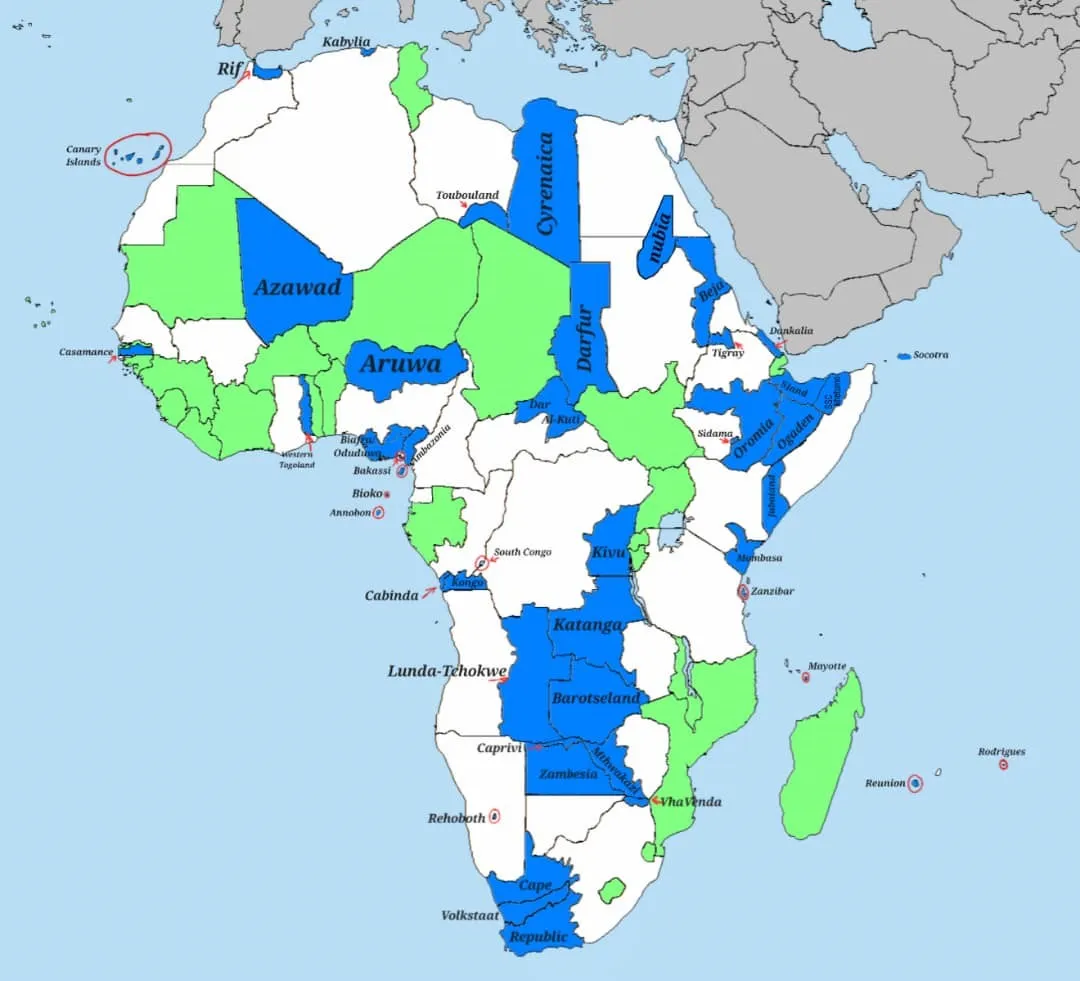
Lagos, Nigeria, Friday, December 26, 2025 - Secessionist movements occupy one of the most sensitive fault lines in Africa’s political history. They sit at the intersection of colonial borders, ethnic identity, resource control, and state legitimacy, often emerging where post-independence governments struggled to reconcile unity with diversity. Yet, despite their frequency, these movements are rarely examined comparatively or ranked with clear analytical grounding.
This article approaches African secessionist movements not as isolated rebellions or moral judgments, but as historical forces that tested the durability of African states. The ranking is based on a set of deliberate criteria like the longevity of each movement, the degree of territorial control achieved, the level of international involvement or recognition, and the extent to which the movement reshaped national or regional political structures. Success is not treated as the sole indicator of importance. In several cases, unresolved or failed movements proved more influential than those that achieved independence.
It is important to stress that this ranking is not rigid or definitive. Secessionist history is inherently subjective, shaped by perspective, access to archives, and evolving political realities. Other analysts may reasonably prioritise different factors and arrive at alternative lists. This ranking reflects our own structured analysis and comparative judgment, offered as a framework for understanding impact rather than a dismissal of competing interpretations.
What follows, therefore, is not a final verdict on Africa’s secessionist past, but a historically grounded attempt to order some of its most significant movements by the weight of their consequences on the continent’s political landscape.
10. Casamance Secessionist Movement (Senegal)
The Casamance secessionist movement emerged formally in the early 1980s through the Movement of Democratic Forces of Casamance (MFDC), rooted in longstanding political and economic grievances rather than sudden ethnic rupture. Casamance’s physical separation from northern Senegal by The Gambia, combined with perceptions of economic neglect and administrative marginalisation, created a durable sense of regional distinctiveness. These conditions produced a secessionist claim that was geographically coherent but politically constrained from the outset.
Unlike higher-ranked movements, the MFDC never achieved sustained territorial control comparable to a de facto state or parallel government. Its armed presence fluctuated across decades, often limited to forested border zones rather than urban centres or administrative capitals. Internal fragmentation further weakened the movement, with rival factions pursuing different strategies ranging from low-level insurgency to negotiated accommodation. This internal division is a key reason Casamance ranks lower despite its longevity.
Internationally, the Casamance issue remained largely insulated from global diplomatic escalation. There was no formal recognition, no sustained multilateral intervention, and limited external mediation beyond regional actors. This absence of internationalisation significantly constrained the movement’s leverage and ensured that the conflict remained framed as a domestic security and governance challenge rather than a self-determination case on the continental stage.
Historically, Casamance’s importance lies less in its threat to Senegal’s territorial integrity and more in what it reveals about the limits of post-independence integration even in relatively stable states. The movement compelled Dakar to rethink decentralisation, military posture in peripheral regions, and conflict resolution strategies, but it never fundamentally altered Senegal’s constitutional or regional order. For these reasons, Casamance earns recognition for endurance and political persistence, while ranking tenth in terms of overall historical impact.
9. Cabinda Independence Movement (Angola)
Cabinda’s secessionist claim predates Angolan independence itself, rooted in colonial-era legal distinctions rather than post-independence rebellion. The territory was administered separately from Angola under Portuguese rule and formalised as a protectorate through the Treaty of Simulambuco in 1885, a document later central to Cabindan separatist arguments. When Portugal moved toward decolonisation in the mid-1970s, Cabindan elites argued that Cabinda’s legal status entitled it to a distinct process of self-determination, separate from Luanda.
This claim was overtaken by events in 1975, when Angola’s independence was declared amid civil war and Cabinda was unilaterally incorporated into the new Angolan state. Armed resistance followed almost immediately, led by the Front for the Liberation of the Enclave of Cabinda (FLEC), which positioned itself not as a rebel faction but as a continuation of an interrupted decolonisation process. Unlike many secessionist movements, Cabinda’s struggle was framed less around ethnic marginalisation and more around treaty law, territorial status, and resource sovereignty.
Cabinda’s strategic importance lay overwhelmingly in its oil reserves, which soon became central to Angola’s post-war economy. By the 1990s, the enclave was producing a substantial share of Angola’s petroleum output, dramatically raising the stakes of any secessionist claim. This economic reality shaped Luanda’s response: a heavy security presence, strict control of political activity, and a refusal to internationalise the issue. The Angolan state treated Cabinda not as a negotiable political question but as a non-negotiable pillar of national survival.
Historically, Cabinda ranks lower not because its claim lacked coherence, but because it failed to translate legal argument and armed resistance into sustained territorial or diplomatic leverage. FLEC fragmented, territorial control remained limited, and no international body formally advanced Cabinda’s case. Yet the movement’s persistence forced Angola to militarise governance in the enclave and entrench a security-first approach to resource-rich peripheries. Cabinda’s significance lies in how early post-independence African states closed the door on treaty-based secession claims, setting a precedent that would echo across the continent.
8. Katanga Secession (Democratic Republic of Congo)
The Katanga secession unfolded at the most fragile moment of Congo’s transition from colonial rule, when sovereignty existed on paper but not yet in institutions. Within weeks of independence in 1960, Moïse Tshombe declared Katanga’s separation, drawing on the province’s long-standing economic autonomy under Belgian administration and its dominance of Congo’s mineral economy. Katanga was not an improvised revolt; it emerged from a political class deeply embedded in colonial corporate structures, particularly those tied to copper and uranium extraction.
Unlike many later secessionist movements, Katanga immediately established the outward markers of statehood. It operated an administration, fielded armed forces, negotiated with foreign interests, and attempted to secure diplomatic legitimacy. European mercenaries and corporate networks provided military and logistical support, while Belgian interests viewed Katanga as a stabilising buffer against a radical central government in Léopoldville. This fusion of local elite politics and international economic stakes gave the secession an influence far beyond Congo’s borders.
Katanga’s collapse was not primarily a military defeat by the Congolese state but the result of unprecedented international intervention. The United Nations Operation in the Congo (ONUC) moved beyond peacekeeping into direct combat against secessionist forces, marking a decisive shift in how the UN interpreted its mandate. The suppression of Katanga between 1962 and 1963 established a critical precedent: that international institutions would actively defend inherited colonial borders, even against administratively viable breakaway entities.
Historically, Katanga ranks eighth because its lifespan was short, but its consequences were profound. The episode hardened Africa’s post-independence norm against secession, influenced the Organisation of African Unity’s commitment to territorial integrity, and shaped future responses to breakaway movements. Katanga demonstrated that economic viability and administrative capacity alone would not guarantee survival in a continental order determined to avoid fragmentation.
7. Ambazonian Secessionist Movement (Cameroon)
The Ambazonian movement did not begin as a secessionist project but as a constitutional dispute rooted in Cameroon’s post-independence settlement. British Southern Cameroons entered the Cameroonian federation in 1961 under a federal arrangement that guaranteed linguistic, legal, and administrative autonomy. That federal structure was dismantled in 1972 through a referendum that replaced it with a unitary state, effectively dissolving the constitutional safeguards that had underpinned Anglophone participation. For decades, grievances were expressed through legal petitions, professional associations, and political lobbying rather than armed resistance.
The shift from reformist agitation to secessionist ideology occurred gradually, and it is crucial to note the timeline. Teachers’ and lawyers’ strikes in 2016 over the erosion of common law and English-language education were initially sectoral disputes, not independence demands. The state’s response to arrests, court bans, and internet shutdowns catalysed radicalisation. By late 2017, independence had become the dominant frame, not because it was historically inevitable, but because federal restoration appeared politically foreclosed. This evolution matters in understanding Ambazonia as a product of institutional collapse rather than primordial separatism.
Unlike Katanga or Biafra, Ambazonia has not achieved consolidated territorial control, but it has established persistent zones of contestation and informal governance. Armed groups operate in rural areas, enforce movement restrictions, and intermittently disrupt state administration, particularly schooling. However, fragmentation remains a defining weakness. Multiple militias with overlapping claims and divergent leadership structures have limited the movement’s ability to project a unified political authority or negotiate from a position of coherence.
Internationally, the Ambazonian case occupies an ambiguous space. It has attracted sustained attention from human rights organisations and diaspora advocacy networks but has not been formally internationalised through multilateral mediation or recognition efforts. No external actor has advanced Ambazonia as a legitimate self-determination case at the level seen in Western Sahara or South Sudan. Its historical significance therefore lies in how a constitutional grievance in a formally bilingual state escalated into a prolonged internal conflict, exposing the fragility of post-colonial legal compromises and the costs of foreclosing negotiated reform.
6. Ogaden / Somali Region Secessionist Movement (Ethiopia)
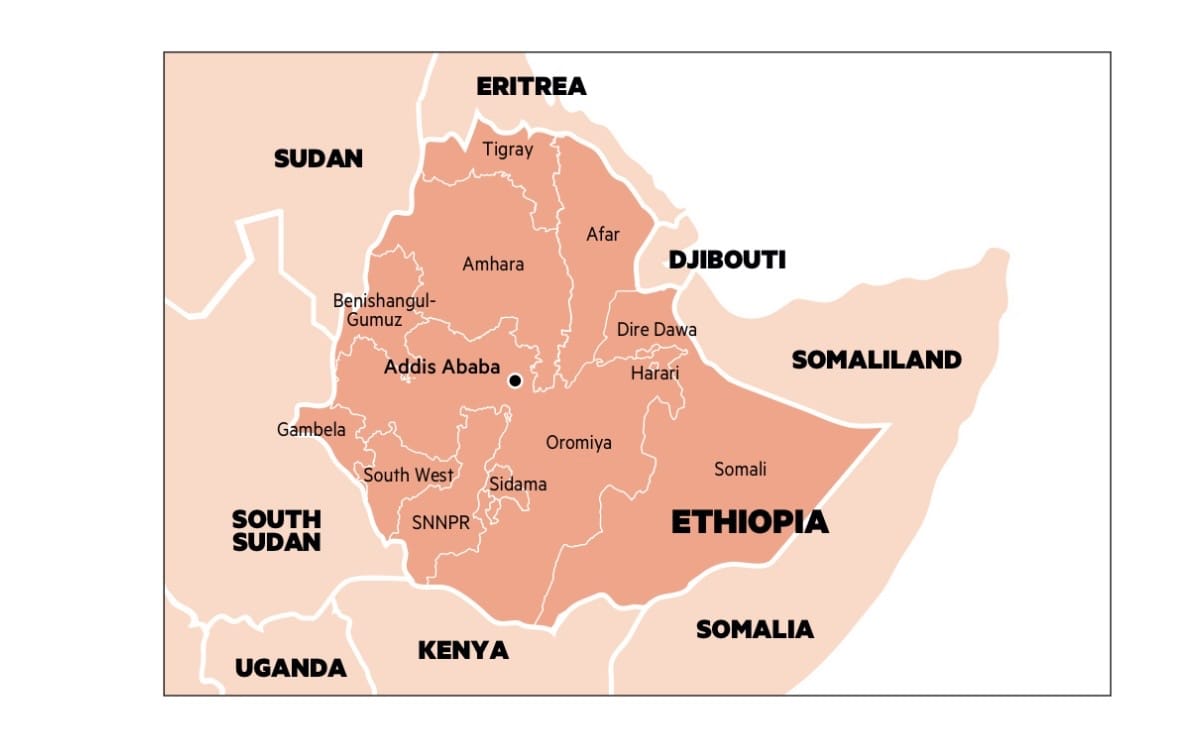
The Ogaden secessionist question is inseparable from the unfinished business of borders in the Horn of Africa. The Somali-inhabited Ogaden region was incorporated into Ethiopia through late-19th-century imperial expansion, long before the emergence of modern African states. This meant that, unlike many post-independence secessionist movements, Ogaden’s claims were anchored in pre-colonial conquest, ethnic continuity across borders, and competing visions of sovereignty rather than grievances arising solely from post-1960 governance failures.
Armed secessionist mobilisation gained clarity in the 1960s and 1970s with the formation of the Western Somali Liberation Front (WSLF), which openly pursued union with Somalia. This aspiration escalated into interstate conflict during the 1977–1978 Ogaden War, when Somalia attempted to annex the region outright. The war’s failure decisively altered the trajectory of the movement. After Ethiopia, backed by Soviet and Cuban support, regained control, Ogaden secessionism shifted from conventional warfare to protracted insurgency, later carried forward by the Ogaden National Liberation Front (ONLF).
Unlike Eritrea, Ogaden never achieved sustained territorial administration or international recognition. However, its strategic weight lay in its ability to internationalise Ethiopia’s internal cohesion problem. The region became a focal point for militarisation, counter-insurgency doctrine, and debates over ethnic self-rule. Persistent conflict in Ogaden forced successive Ethiopian governments to confront the limits of centralised rule, directly influencing the adoption of ethnic federalism in the 1995 constitution. Even when autonomy was granted on paper, enforcement remained contested, underscoring the gap between federal design and lived political reality.
Historically, Ogaden ranks sixth because its secessionist project neither collapsed quickly nor succeeded outright, but instead reshaped Ethiopia’s internal architecture and regional relations. It demonstrated how unresolved border questions could blur the line between secession, autonomy, and irredentism, drawing neighbouring states into domestic conflicts. Its legacy is visible not in independence, but in the security-heavy governance of Ethiopia’s peripheries and the enduring instability of the Horn of Africa’s borderlands.
5. Eritrean Secessionist Movement (Ethiopia)
Eritrea’s path to independence stands apart in African secessionist history because it was neither a sudden rupture nor a reaction to immediate post-independence exclusion. Eritrea entered the Ethiopian state through a UN-brokered federation in 1952, a compromise that granted internal autonomy while preserving Ethiopian sovereignty. That arrangement was systematically dismantled over the following decade, culminating in Ethiopia’s formal annexation of Eritrea in 1962. Secessionist mobilisation therefore emerged not as an abstract claim, but as a response to the collapse of an internationally guaranteed political settlement.
Armed resistance began with the Eritrean Liberation Front (ELF) and later consolidated under the Eritrean People’s Liberation Front (EPLF), whose organisational discipline and territorial strategy set it apart from most African insurgencies. By the late 1970s and 1980s, the EPLF controlled significant rural areas, operated administrative structures, and developed a self-reliant military and social system under wartime conditions. This capacity for sustained governance under conflict was critical to the movement’s durability and eventual success.
Internationally, Eritrea benefited less from early diplomatic recognition than from shifts in regional and global power. The collapse of Ethiopia’s Derg regime in 1991 fundamentally altered the balance, allowing Eritrean forces to enter Asmara as de facto victors rather than negotiated secessionists. Independence was formalised through a UN-supervised referendum in 1993, giving Eritrea one of the most procedurally legitimate secessions on the continent. The process reinforced the idea that long-running, internally coherent movements could achieve statehood within the existing international order.
Eritrea ranks fifth rather than higher because, while its success was undeniable, its broader continental impact was more contained than unresolved cases such as Western Sahara or systemic shocks like Biafra. Its legacy lies in demonstrating that secession could succeed through endurance, organisational capacity, and strategic timing rather than external sponsorship alone. At the same time, Eritrea’s later authoritarian trajectory complicates its historical narrative, underscoring that successful secession does not automatically translate into stable post-independence governance.
4. Biafran Secession (Nigeria)
The Biafran secession emerged from a complex matrix of ethnic tensions, political marginalisation, and post-colonial state fragility. Following independence in 1960, Nigeria’s federal system was undermined by coups, massacres, and political realignments that left the Eastern Region, dominated by the Igbo, feeling vulnerable to domination by northern and western elites. By May 1967, Lieutenant Colonel Odumegwu Ojukwu declared the independent Republic of Biafra, framing secession as both a survival strategy and a political assertion of self-determination.
Biafra achieved a remarkable level of territorial and administrative control, establishing civil institutions, issuing currency, and maintaining an organised military force. Its initial success challenged the Nigerian state’s capacity to govern and forced a rapid federal military response. The secession also attracted international attention, while few countries recognised Biafra formally, the conflict sparked global humanitarian mobilisation, including media coverage and aid operations that highlighted famine and civilian suffering as central to the war.
The war’s intensity and humanitarian dimension had lasting consequences. Nigeria’s eventual victory in 1970 preserved national unity, but the conflict reshaped federalism, military organisation, and approaches to ethnic inclusion. Post-war policy prioritised central authority and reconciliation, influencing constitutional reform and security doctrine for decades. Biafra remains a reference point in discussions of ethnic self-determination, humanitarian law, and the limits of secessionist claims within Africa’s post-colonial borders.
Biafra ranks fourth not due to failure, but because of its extraordinary short-term impact. The combination of military mobilisation, civilian suffering, and global attention made it a defining moment in African post-colonial history. Its legacy persists in both Nigerian statecraft and in the broader discourse on secession, demonstrating how attempted independence can influence national policy, international perception, and humanitarian norms even when ultimate political objectives are unmet.
3. Somaliland Secession (Somalia)
Somaliland’s secessionist trajectory is distinct because it rests on both historical precedent and sustained institutional development rather than short-term conflict. The territory, formerly British Somaliland, entered the Somali Republic through unification with the former Italian Somaliland in 1960. Early dissatisfaction emerged over centralisation and political marginalisation, but the movement for independence did not crystallise until after the collapse of Somalia’s central government in 1991. At that point, Somaliland declared independence, arguing that its voluntary union in 1960 had been violated by decades of neglect, authoritarianism, and civil war.
Unlike many other secessionist movements, Somaliland established functioning governance structures almost immediately. It maintained administrative continuity from colonial rule, held competitive local elections, and built a security apparatus capable of enforcing law and order. Its stability contrasts sharply with the surrounding chaos in Somalia, giving the movement a unique legitimacy in terms of practical governance even though formal international recognition remains absent. This longevity and consistency underpin its historical significance: Somaliland has survived for more than three decades as a de facto state.
Economically and socially, Somaliland has leveraged internal cohesion to foster infrastructure, trade, and a degree of fiscal autonomy, particularly in its ports and livestock markets. These achievements demonstrate that secessionist success is not measured solely by diplomatic recognition but also by the ability to maintain viable institutions and citizen compliance. This pragmatic statecraft has allowed Somaliland to avoid the persistent violence seen in many other secessionist cases, giving it a distinctive position in African political history.
Internationally, Somaliland occupies an ambiguous but instructive space. No UN member state formally recognises it, but it maintains informal diplomatic relations and attracts development assistance. Its case has influenced debates on the criteria for statehood, particularly in Africa, and has provided a comparative model for conflict resolution and federal negotiation in post-colonial contexts. Somaliland ranks third because, while it has not achieved legal recognition, its sustained governance, territorial control, and relative peace set it apart from nearly all other African secessionist movements. It exemplifies how enduring, locally legitimate state structures can redefine the boundaries of practical sovereignty.
2. South Sudan Secession (Sudan)
South Sudan’s secession represents the most consequential 21st-century territorial reconfiguration in Africa and one of the continent’s most meticulously documented independence movements. Its origins lie in decades of marginalisation and conflict between the predominantly Arab-Muslim north and the predominantly African-Christian and animist south. The first civil war (1955–1972) set the stage for protracted resistance, while the second civil war (1983–2005), led by the Sudan People’s Liberation Movement/Army (SPLM/A), combined military strategy, political organisation, and international diplomacy to sustain the movement over more than two decades.
Unlike many historical secessionist movements, South Sudan combined territorial control with institutional administration. SPLA units effectively governed large swathes of southern Sudan, providing social services, taxation, and local security. This ability to exercise quasi-state functions made the movement more than a military insurgency; it was a prolonged state-building project within the boundaries of an existing state. This level of governance, sustained under extreme conditions of war and displacement, allowed South Sudan to present itself as a viable candidate for independent statehood.
International involvement was decisive in shaping the outcome. Peace negotiations culminated in the 2005 Comprehensive Peace Agreement (CPA), which established autonomy, security arrangements, and a referendum on independence. Global actors including the UN, African Union, and neighbouring states played a mediating role, ensuring that the secession occurred through a structured, internationally recognised process. The 2011 referendum, with an overwhelming vote for independence, marked the culmination of a historically unprecedented and carefully mediated secession in Africa.
South Sudan ranks second because it exemplifies the full spectrum of successful secessionist criteria which is longevity, territorial control, administrative capacity, and international legitimacy. Its emergence redefined Sudan, reshaped regional security dynamics in East Africa, and set a benchmark for self-determination under international law. The case underscores how a combination of internal coherence, armed endurance, and diplomatic engagement can translate historical grievances into formal statehood.

1. Western Sahara / Sahrawi Arab Democratic Republic (SADR)
The Western Sahara secessionist movement stands as Africa’s longest unresolved territorial conflict, its significance rooted in both historical claims and ongoing geopolitical consequences. The territory, formerly Spanish Sahara, was administratively distinct under colonial rule, and its decolonisation process was left incomplete when Spain withdrew in 1975. Morocco and Mauritania moved to annex the region, ignoring the Sahrawi population’s long-standing aspiration for self-determination. This prompted the Polisario Front, formed in 1973, to initiate a formal armed struggle to establish an independent state, ultimately declaring the Sahrawi Arab Democratic Republic (SADR) in 1976.
Unlike many secessionist movements, the Polisario Front quickly established functional governance in the areas under its control, including refugee camps in Algeria and liberated territories inside Western Sahara. Administrative structures, education, and social services were organised despite limited resources and the pressures of protracted conflict. The movement has maintained a coherent political identity for nearly five decades, demonstrating endurance unmatched by most African secessionist struggles.
Internationally, the Western Sahara conflict has produced profound legal and diplomatic consequences. The United Nations has recognised the Sahrawi right to self-determination, and the issue remains on the UN agenda, influencing African Union policy and North African geopolitics. The unresolved status of the territory has shaped Morocco’s regional strategy, diplomatic alignments, and security policies, while also generating periodic flare-ups that affect border security, migration, and international trade routes.
Western Sahara ranks first because of the combination of its historical legitimacy, enduring organisational capacity, unresolved international status, and regional impact. Unlike other movements, it demonstrates that secessionist significance is not measured solely by success or failure: longevity, diplomatic weight, and the challenge it poses to state sovereignty make Western Sahara the defining case of African secessionist struggle. Its continued relevance underscores the persistent tension between colonial legacies, self-determination, and the African principle of territorial integrity.
Across Africa, secessionist movements have shaped state formation, regional stability, and international diplomacy in ways that extend far beyond individual conflicts. These movements reveal patterns of governance, identity, and negotiation that continue to influence political strategy, border management, and the balance between self-determination and territorial integrity. Understanding them comparatively highlights the complexity of African statehood and the enduring tension between central authority and local aspiration, offering lessons for policymakers, scholars, and citizens navigating the continent’s evolving political landscape.