Table of Contents
In Summary
- Visa openness in Africa increasingly reflects administrative capacity and policy intent rather than just income and global influence.
- Small and mid-sized states dominate the top tier, showing that mobility reform is primarily a governance decision, not a resource-heavy one.
- Countries scoring above 0.80 are consistently aligning their visa policies with regional integration, investment strategies, and labor mobility goals.
Deep Dive!!
Lagos, Nigeria, Wednesday, December 17 - In Africa, the ability to move across borders is increasingly a measure of a state’s governance effectiveness and regional strategy. Visa policies signal how governments manage trade, tourism, investment, and diplomacy, reflecting both institutional capacity and long-term planning. Mobility has become a lens through which the continent’s political and economic architecture can be understood.
This ranking according to the 10th edition of the African Visa Openness Report examines African countries in early 2025 based on how accessible they make their borders to other African nationals. Scores capture the ease of entry whether visa-free, via visa-on-arrival, or through streamlined electronic applications while considering the predictability and consistency of these policies.
A higher score reflects fewer barriers and also the presence of institutional frameworks capable of enforcing and managing movement efficiently. The measure is not only about migration volumes or security outcomes, but also about policy design, implementation capacity, and administrative reliability.
Beyond numbers, visa openness reveals much about how states position themselves within Africa’s shifting political and economic landscape. Countries with higher openness scores often use mobility strategically. They use mobility to facilitate regional trade, support tourism-dependent economies, or signal alignment with frameworks such as the African Continental Free Trade Area (AfCFTA) and the East African Community.
By ranking the top ten countries, this article highlights where visa policies intersect with governance priorities, institutional strength, and continental engagement, offering a window into both current practices and the evolving path of African statecraft.
10. Sierra Leone
Sierra Leone’s visa openness profile in early 2025 reflects a state that has learned to treat mobility policy as a matter of institutional credibility rather than public signaling. With an openness score settling at 0.811, the country’s approach is neither experimental nor passive. Instead, it has been shaped by the long memory of post-conflict reconstruction, where border control, identity management, and administrative order were central to restoring state authority. Visa reform has therefore emerged slowly, embedded within broader efforts to rebuild trust in government systems and normalize Sierra Leone’s place within West African political and economic networks.
At the administrative level, visa openness has advanced through pragmatic adjustments rather than structural overhaul. Immigration processes have been simplified for African nationals, particularly through expanded visa-on-arrival access and reduced discretionary barriers at points of entry. These changes, however, operate within a civil service that remains capacity-constrained and unevenly resourced. The 0.811 score reflects this tension clearly showing how policy intent has outpaced institutional reach. While the central government has articulated openness as compatible with security and sovereignty, implementation varies across airports, seaports, and land borders, revealing the limits of bureaucratic standardization in a system still consolidating itself.
Politically, visa openness in Sierra Leone has never been framed as a flagship reform. Successive administrations have avoided presenting border liberalization as a standalone achievement, preferring to subsume it under wider narratives of economic recovery, tourism development, and regional cooperation. This restraint is deliberate. In a domestic context where unemployment, public service delivery, and fiscal pressure dominate political debate, visa policy is treated as a supportive instrument rather than a political centerpiece. The result is a form of openness that is steady and credible, but carefully insulated from populist pressures or sudden reversals.
Regionally, Sierra Leone’s visa posture aligns closely with ECOWAS norms while cautiously extending beyond them. The country’s openness score places it comfortably among Africa’s more accessible destinations without pushing it into the highest tier of liberalization. This positioning reflects a strategic choice that is to be seen as cooperative and predictable rather than aggressively competitive. In practical terms, Sierra Leone’s visa regime functions as a signal of reliability to African travelers, investors, and diplomats, while preserving enough administrative discretion to manage internal constraints. Its experience illustrates how visa openness, when pursued as a governance process rather than a political statement, can reinforce state stability even in systems still completing their institutional recovery.

9. Burundi
Burundi’s visa regime in early 2025 sits at a distinctly transactional and state-centric intersection. The country has engineered practical entry pathways for visitors while preserving tight administrative oversight. With an openness score of 0.823, Bujumbura’s policy mix gives priority to controlled access rather than unconditional liberalization. The government offers both a visa-on-arrival at Melchior Ndadaye International Airport and an online e-visa system, with the standard tourist/business entry calibrated around a roughly USD 90 one-month fee (with longer online options available), making the state’s intent clear to facilitate measured short-term mobility while keeping the bureaucratic levers firmly in government hands.
That controlled facilitation is the product of deliberate institutional design. The Commissariat Général des Migrations (CGM), the operational arm responsible for entry, exit, and visa follow-up, sits physically in Kigobe near the Assembly and has consolidated visa services, e-visa appointments, and extensions under a single administrative portal and desk system. Travelers are required to complete an incoming/outgoing passenger form for airport arrivals and the CGM handles renewals and longer stays through in-person procedures. These features reflect a system that prefers paper-trail governance and in-person oversight rather than fully devolved, trust-based access. The CGM’s public portal and the Ministry of Foreign Affairs visa pages thus act as both service channels and checkpoint instruments for internal migration control.
Politically, visa policy in Burundi cannot be divorced from the state’s security posture and diplomatic choices since 2020. The ruling apparatus has treated border policy as an element of sovereignty and regime assurance, that is, liberal enough to keep trade and diplomacy functioning, but designed so that external movement does not outpace internal capacity for monitoring and consular protection. That calculation is visible in how the government has preserved visa-on-arrival and e-visa access while maintaining governance prerogatives over extensions, work authorizations, and the accreditation of recruitment agencies which is an issue that surfaced in reporting on labour migration abuses and the role of intermediaries where the Commissariat and recruitment regulation intersect. This is an administrative stance meant to maximize foreign exchange and regional connectivity while retaining centralized oversight over cross-border human flows.
Regionally, Burundi’s practice reflects both East African Community obligations and pragmatic hedging. As an EAC member since the late 2000s, Burundi aligns with common-market rhetoric but often implements commitments in calibrated steps that respect domestic governance limits. The country’s selective openness, easier access for short-term visitors, formalized e-visa pathways, and consolidated renewal procedures at the CGM makes Bujumbura a predictable partner for diplomats, regional business visitors, and humanitarian actors while preserving tools to respond quickly to security or political contingencies. For analysts, Burundi therefore offers a model of “managed openness”: policy choices that unlock mobility benefits without ceding administrative control, a posture that will likely persist so long as state capacity and political priorities favor central oversight over broad, fast-moving liberalization.
8. Mauritius
Mauritius approaches visa openness as part of a wider state strategy that links mobility directly to economic planning, regulatory clarity, and institutional reliability. With a visa openness score of 0.826 in early 2025, the country’s policy framework reflects long-standing confidence in its border management systems rather than recent experimentation. Unlike states that liberalize visas to compensate for weak attractiveness, Mauritius uses openness to reinforce an already structured position as a financial, tourism, and services hub in the Indian Ocean and wider African space.
Administratively, visa policy is anchored within a coordinated system involving the Passport and Immigration Office, the Prime Minister’s Office, and economic agencies such as the Economic Development Board. African nationals benefit from visa-free entry or visa-on-arrival access for defined short stays, typically aligned with tourism, business visits, and regional meetings. What distinguishes Mauritius is not simply access, but predictability. Entry rules are clearly published, consistently applied at Sir Seewoosagur Ramgoolam International Airport, and supported by relatively strong data management and identity verification systems. This institutional consistency explains why openness does not translate into policy anxiety or frequent reversals.
Politically, visa openness in Mauritius has never been framed as a concession or a risk. It is treated as an extension of the country’s economic model, which prioritizes external engagement, services exports, and investment inflows. Initiatives such as long-stay visas for investors, professionals, and remote workers operate alongside African mobility policies without contradiction, because the state has confidence in its screening capacity and enforcement mechanisms. As a result, visa openness is embedded in governance practice rather than politicized in domestic debate, a sharp contrast to countries where border policy becomes entangled with electoral pressure or security rhetoric.
Mauritius uses visa openness as a diplomatic and economic positioning tool rather than a gesture of solidarity alone. While geographically distant from continental Africa, the country has consistently aligned its entry regime with its Africa-facing ambitions in finance, aviation, and trade facilitation. The 0.826 score reflects this balance. It is open enough to support mobility and partnership, yet structured enough to maintain administrative order. Mauritius demonstrates how visa openness can function effectively when it is supported by strong institutions, clear policy objectives, and a political culture that treats mobility as a managed public function rather than an ideological choice.
7. Mozambique
Mozambique’s visa openness in early 2025 reflects a state using mobility policy to support economic recovery, regional trade, and corridor-based integration rather than broad diplomatic signaling. With an openness score of 0.842, the country has positioned its visa framework as a functional tool linked to transport routes, port activity, and energy investment zones. Visa reform has moved in parallel with Mozambique’s efforts to stabilize macroeconomic management and restore investor confidence following debt restructuring and renewed focus on extractive-led growth.
Mozambique has expanded visa-on-arrival access for African nationals at key entry points, including Maputo International Airport and selected land borders tied to high-volume regional traffic. These reforms sit within the authority of the National Immigration Service under the Ministry of the Interior, which has emphasized standardized entry procedures and clearer fee structures. While capacity gaps remain, especially at secondary border posts, the core visa system benefits from Mozambique’s long experience managing cross-border movement with South Africa, Eswatini, Zimbabwe, and Tanzania. The 0.842 score reflects this practical competence: entry rules are increasingly clear and enforceable, even if service quality varies by location.
Visa openness has been treated as an enabling policy rather than a public-facing reform. The government’s focus has been on reducing friction for regional traders, contractors, and project-linked travel connected to ports such as Maputo, Beira, and Nacala, as well as energy developments in Cabo Delgado. This approach explains why visa liberalization has advanced even amid security challenges in the north. The state has separated mobility facilitation from counterinsurgency operations, ensuring that border policy continues to support economic activity while security responses remain geographically targeted and institutionally distinct.
Mozambique’s visa posture aligns with Southern African Development Community norms and its role as a transit economy. Openness supports labor mobility, logistics flows, and service provision tied to neighboring landlocked states. At the same time, the government has retained administrative controls over work authorization and long-term stays, ensuring that short-term access does not translate into unmanaged settlement. Mozambique’s experience shows how visa openness can be scaled within a complex political economy, where mobility is treated as infrastructure for growth rather than a symbolic commitment. Its 0.842 score captures a system that is functional, regionally anchored, and closely linked to the country’s development corridors and institutional priorities.
6. Cabo Verde
Cabo Verde’s visa openness reflects a long-standing state practice built around external access, administrative clarity, and reputational consistency rather than recent reform momentum. With a visa openness score of 0.864 in early 2025, the country’s approach is rooted in its structural reality as an island economy whose political stability and fiscal sustainability depend heavily on controlled openness. Mobility policy in Cabo Verde has therefore evolved as a core governance function, closely tied to tourism management, diaspora relations, and international credibility.
Institutionally, visa administration is handled through a relatively streamlined system coordinated by the Direção de Estrangeiros e Fronteiras (DEF) under the Ministry of Internal Administration, with operational integration at ports of entry such as Nelson Mandela International Airport on Santiago Island and Amílcar Cabral International Airport on Sal. African nationals benefit from visa-free or simplified entry arrangements, complemented by pre-registration systems that allow the state to retain advance passenger information without reintroducing restrictive visa barriers. This model reflects an administrative culture that prioritizes predictability and data capture over discretionary decision-making at the border.
Politically, visa openness in Cabo Verde is treated as a settled policy choice rather than a contested issue. The country’s multiparty system, stable electoral transitions, and strong reliance on external partners have produced a broad consensus around openness as a national interest. Successive governments have framed entry policy as part of public order and economic management, not as an ideological position. This consensus has allowed Cabo Verde to maintain consistent visa rules across political cycles, a factor that materially contributes to its relatively high openness score of 0.864. Unlike larger states where border policy is frequently recalibrated in response to domestic pressure, Cabo Verde’s visa framework has been insulated from short-term political shifts.
Regionally and continentally, Cabo Verde uses visa openness to offset geographic distance from mainland Africa. By lowering administrative barriers, the state reinforces its participation in African diplomatic, business, and institutional networks despite its island location. At the same time, openness is balanced with firm controls on length of stay, employment authorization, and residency pathways, areas where the state retains clear regulatory authority. Cabo Verde’s visa regime demonstrates how a small state can combine openness with administrative discipline, using mobility policy to sustain economic inflows, preserve public order, and reinforce its reputation as a predictable and well-governed African jurisdiction.
5. Ghana
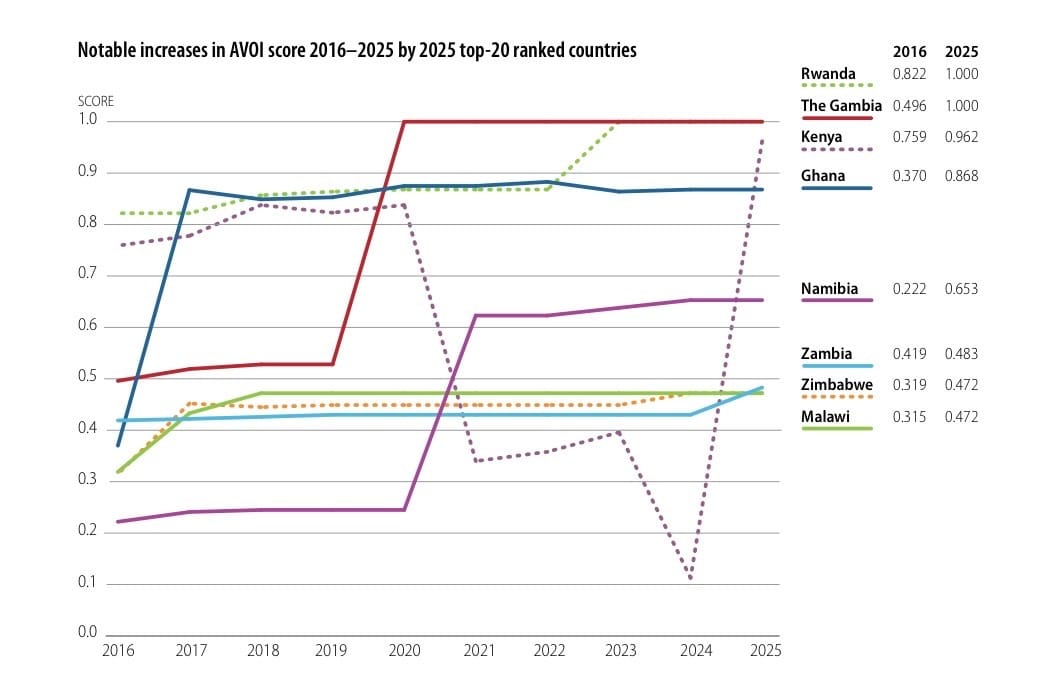
Ghana’s visa policy in early 2025 reflects a deliberate balance between facilitating regional mobility and maintaining institutional control, resulting in an openness score of 0.868. Unlike some states that prioritize liberalization for optics or tourism alone, Accra’s approach is closely linked to broader governance objectives, including trade facilitation, regional integration, and diaspora engagement. Ghana has treated visa policy as both an administrative instrument and a signaling mechanism, projecting reliability to investors and African travelers while retaining oversight over migration flows.
Operationally, the country has integrated visa-on-arrival and e-visa services for African nationals, coordinated through the Ghana Immigration Service (GIS) and supported by the Ministry of Foreign Affairs and Regional Integration. Key points of entry such as Kotoka International Airport and land crossings at Aflao, Elubo, and Paga have seen standardized procedures, digitized application tracking, and streamlined clearance protocols. These reforms are not superficial. GIS maintains monitoring and enforcement units at border posts and liaises with domestic security agencies to ensure that short-term mobility does not undermine national security or regulatory compliance. This level of institutional integration underpins the country’s relatively high openness score.
Ghanaian visa policy has also evolved alongside the country’s positioning as a hub for regional business and continental diplomacy. Governments have used controlled openness to reinforce Accra’s role in ECOWAS initiatives and continental projects, particularly in infrastructure and trade facilitation. Visa rules are deliberately structured to favor predictable access for regional entrepreneurs, civil servants, and tourists, while extending more limited pathways for longer-term stays, such as work or study. This approach reflects an administrative culture that values predictability and institutional continuity, minimizing opportunities for politicization or abrupt policy shifts.
In addition, Ghana leverages visa openness to support both economic and diplomatic objectives. Its relatively high score demonstrates a commitment to facilitating intra-African movement, particularly for business and official travel, while maintaining a carefully managed system that protects national interests. The alignment of visa facilitation with regional integration projects and diaspora engagement initiatives highlights Accra’s understanding of mobility as a tool of statecraft rather than a discretionary concession. Ghana exemplifies how visa openness can simultaneously support continental cooperation and safeguard domestic governance objectives, reinforcing both institutional credibility and strategic positioning in West Africa.
4. Benin
Benin’s visa policy in early 2025 reflects a strategic embrace of regional connectivity while carefully managing administrative capacity, resulting in an openness score of 0.906. Porto-Novo and Cotonou have positioned the country as a key transit and trade hub in West Africa, with visa regulations tailored to facilitate business, cross-border commerce, and diplomatic engagement. Unlike some neighbors that liberalize for political optics, Benin’s approach is a product of deliberate policy design aimed at reinforcing institutional credibility and economic integration within ECOWAS and the wider region.
At the operational level, the Ministry of Interior and the Direction Générale de la Migration (DGM) coordinate entry processes for African nationals through both visa-on-arrival and e-visa channels. Key entry points, including Cadjehoun Airport and land crossings at Sèmè-Kraké and Porga, have implemented standardized electronic registration and document verification systems. The DGM maintains a real-time monitoring interface, linking immigration checkpoints with domestic security and trade authorities. This integration ensures that openness is complemented by regulatory oversight, supporting predictable mobility without compromising border control.
Politically, Benin’s approach to visa openness reflects a broader governance philosophy emphasizing stability, economic pragmatism, and incremental reform. Policymakers have leveraged mobility as a mechanism to attract investment and facilitate regional trade while avoiding the security and administrative risks associated with sudden liberalization. Visa policy has been structured to provide reliable access for businesspersons, civil servants, and short-term travelers, with long-term stays still subject to rigorous vetting and consular oversight. This balance demonstrates an understanding that state credibility and institutional efficiency are central to the success of openness reforms.
Regionally, Benin has positioned itself as both a facilitator and a regulator of African mobility. Its 0.906 score underscores a high level of administrative coherence and policy foresight. By enabling controlled access for travelers while retaining structured oversight, Benin strengthens its role in regional economic corridors and diplomatic networks. The country demonstrates that visa openness, when aligned with institutional capacity and strategic goals, can enhance regional integration without undermining governance stability, making it a model for mid-sized West African states navigating mobility reforms.
3. Kenya
Kenya’s visa openness in early 2025, reflected in a score of 0.962, represents a deliberate strategy to consolidate Nairobi’s role as East Africa’s commercial and diplomatic hub. Unlike smaller states where openness is often symbolic, Kenya leverages visa policy as a core component of its regional influence and economic strategy. Over the past decade, reforms have been tightly integrated with Kenya’s position in the East African Community (EAC) and its ambition to maintain Nairobi as the primary gateway for regional business, conferences, and tourism.
The Ministry of Interior and Coordination of National Government, in collaboration with the Directorate of Immigration Services, has implemented a digital e-visa platform that allows African nationals simplified online access for both short-term business and tourism. This system is linked to the Integrated Population Registration System (IPRS), enabling seamless verification of travelers’ identity and residency history. Nairobi’s Jomo Kenyatta International Airport has been a testing ground for these reforms, integrating biometric entry and pre-clearance processes that reduce bottlenecks for frequent travelers and cross-border entrepreneurs. Kenya’s high score reflects not only policy design but also administrative capacity to enforce and monitor compliance efficiently.
Politically, visa openness in Kenya operates within a complex landscape of national security, border management, and regional diplomacy. The government has carefully calibrated entry policies to facilitate trade and investment while maintaining control over informal migration corridors along the border with Uganda, Tanzania, and South Sudan. Legislative oversight by parliament and continuous engagement with the National Security Advisory Committee ensure that policy changes balance economic imperatives with domestic security concerns. This duality maximizing mobility benefits while preserving oversight has made Kenya a benchmark in East Africa for predictable and structured visa access.
Regionally, Kenya’s openness reinforces its diplomatic leverage in the EAC and continental frameworks such as the African Continental Free Trade Area (AfCFTA). By easing access for African nationals, Nairobi encourages business linkages, regional conferences, and intergovernmental collaboration, effectively positioning visa policy as a tool of statecraft rather than a mere administrative convenience. Its score of 0.962 reflects both operational efficiency and the strategic use of mobility to project Kenya as an indispensable hub for commerce, governance, and continental engagement.
2. Rwanda
Rwanda’s perfect visa openness score of 1.000 in early 2025 reflects decades of deliberate institutional design and strategic policymaking. Kigali has consistently treated visa policy as a tool to reinforce state credibility, economic competitiveness, and continental positioning, rather than merely a procedural necessity. The origins of this approach lie in Rwanda’s post-genocide reconstruction: after 1994, rebuilding public trust, stabilizing institutions, and attracting international investment were central priorities, and the government quickly recognized that mobility policy could signal both competence and predictability to the outside world.
The operational architecture behind Rwanda’s openness is distinctive. The Directorate General of Immigration and Emigration, under the Ministry of Internal Security, has integrated visa-on-arrival and e-visa systems through the IREMBO platform, a digital service hub that initially managed citizen services but now also facilitates entry for foreign nationals. Biometric verification is applied at key points such as Kigali International Airport, Gatuna border with Uganda, and Akanyaru crossing with Burundi, while the system links with domestic law enforcement and economic agencies to track compliance and support investment facilitation. The sophistication of these digital tools is uncommon in the region, allowing Rwanda to grant African nationals seamless entry without sacrificing oversight.
Rwanda’s visa openness is closely tied to its economic and diplomatic strategy. By removing barriers for African travelers, Kigali enhances its role as a hub for conferences, trade missions, and regional partnerships, including with the African Continental Free Trade Area and East African Community projects. Short-term travelers for business or tourism are prioritized, while longer stays, work permits, and residence applications are processed within strict regulatory frameworks, ensuring that openness does not compromise internal governance. This duality illustrates Rwanda’s capacity to deploy visa policy as a precise governance instrument rather than a generic facilitation measure.
The country’s political culture reinforces this approach. Visa openness is integrated into a broader narrative of predictable, efficient governance, projecting a reputation of institutional reliability to investors, diplomats, and regional partners. Kigali has also leveraged its open visa policy as a component of soft power. It signals stability and order in a region where mobility is often hampered by inconsistent border practices. By combining digital infrastructure, capacity-building at border posts, and carefully calibrated regulatory oversight, Rwanda demonstrates how visa policy can simultaneously enhance regional influence, attract investment, and maintain tight internal control, making its perfect 1.000 score both a reflection of policy design and a symbol of strategic statecraft.
1. The Gambia
The Gambia’s visa openness score of 1.000 in early 2025 reflects a calculated strategy of leveraging mobility to enhance its regional influence, tourism sector, and diplomatic profile, despite its small geographic size. Unlike larger African states, Banjul has used visa policy as a precise instrument to compensate for limited territorial and economic weight, turning administrative accessibility into a soft-power advantage. Over the past decade, successive governments have pursued a deliberate policy of controlled liberalization, ensuring that the country is accessible to African travelers while maintaining tight oversight over borders, entry compliance, and migration flows.
A distinctive feature of The Gambia’s approach is its integration of visa facilitation with tourism and economic planning. Banjul International Airport and key riverine crossings along the Senegal border have been upgraded with electronic entry systems and visa-on-arrival counters, allowing African nationals to obtain travel authorization efficiently. The government coordinates the Immigration Department with the Ministry of Tourism and Culture, ensuring that visa policies directly support the country’s principal sources of foreign exchange. Seasonal and short-term visas are designed to attract tourists and business visitors during peak travel periods, with administrative controls in place to prevent overstays and enforce regulatory compliance, reflecting a nuanced balance between openness and governance.
Politically, The Gambia’s visa policy has also served as a statement of regional integration commitment. The country has been an active participant in ECOWAS mobility initiatives, extending simplified entry procedures for citizens of neighboring states while maintaining rigorous administrative verification to prevent irregular migration. This positioning enhances Banjul’s credibility as a partner in regional trade, diplomacy, and cross-border security cooperation. Unlike states where visa liberalization is reactive or ad hoc, The Gambia has embedded openness into a consistent policy framework, signaling reliability and predictability to both regional actors and international investors.
The Gambia’s high score is further tied to institutional efficiency and the use of technology. Beyond e-visas and border automation, the government has introduced centralized databases linking the Immigration Department with law enforcement and civil registry systems, allowing for real-time tracking of travelers. This integration enables rapid response to irregularities while maintaining an essentially frictionless experience for authorized visitors. By embedding visa openness into a broader governance ecosystem, The Gambia demonstrates how a small state can leverage administrative precision, strategic planning, and regional engagement to punch above its weight, making its perfect score a reflection of both policy foresight and practical statecraft.
Across Africa, the 2025 visa openness rankings reveal a continent where mobility is increasingly treated as a deliberate governance tool rather than a symbolic reform. Looking at Sierra Leone’s cautious yet functional access, Rwanda and The Gambia’s strategic, fully streamlined openness, states are linking visa policy to institutional credibility, economic corridors, and regional influence in ways that reflect their unique capacities and priorities. Looking ahead, the trend suggests that more African governments will continue to calibrate visa regimes to support investment, trade, and integration, using mobility not only to facilitate movement but also as a subtle instrument of statecraft that strengthens both domestic governance and continental cooperation.