Table of Contents
The 2026 Global Outsourcing Talent Index has officially redrawn the world’s economic borders. For the first time, African nations account for 28% of the world’s top 25 outsourcing destinations. Led by South Africa and Nigeria—who have both broken into the global top ten—the continent is no longer just an "alternative" to Asia or Europe; it is becoming the primary choice for global businesses with outsourcing needs seeking a rare combination of high English proficiency and unbeatable labor cost competitiveness
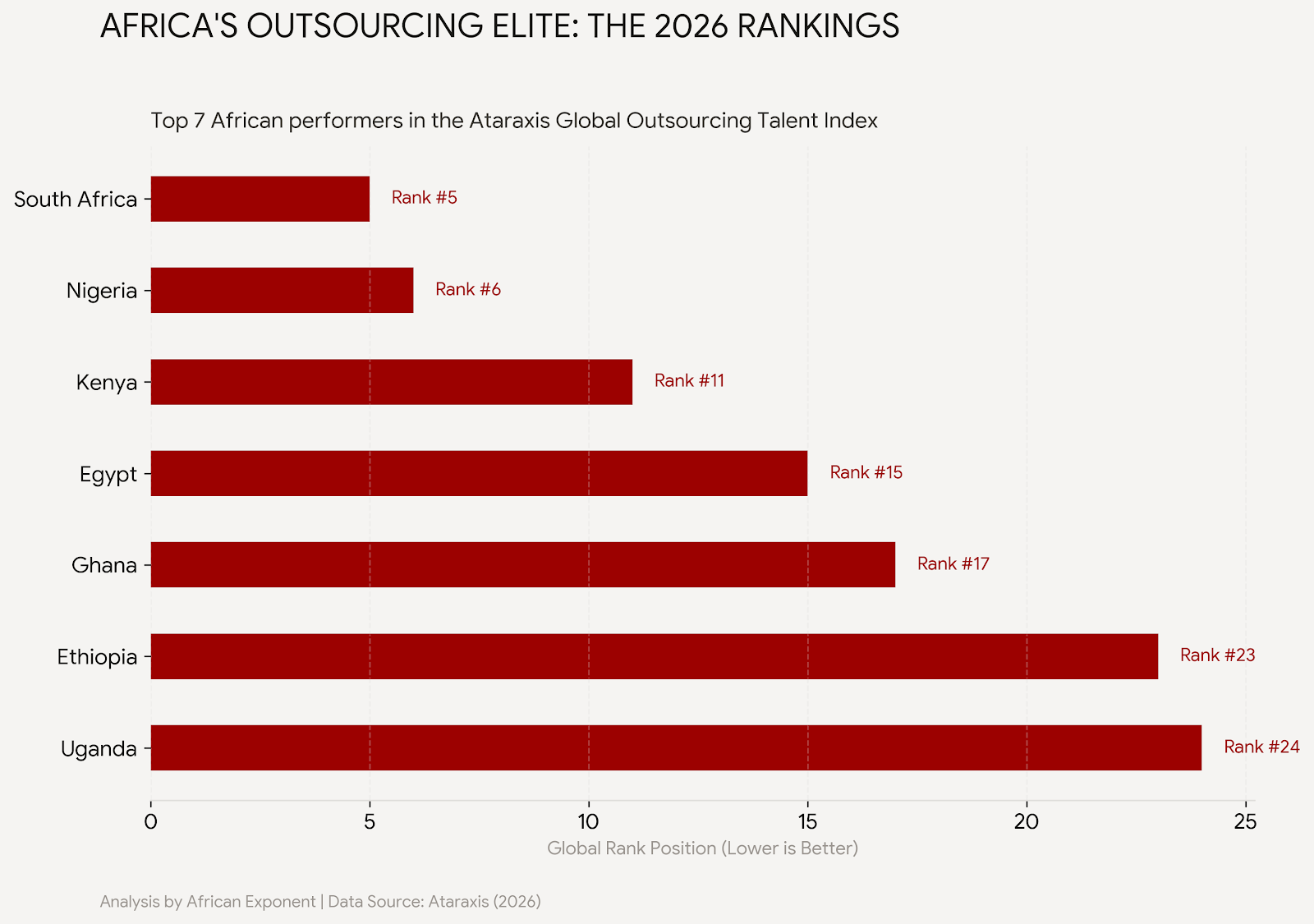
The Continental Shift: In a historic 2026 realignment, African nations now command 28% of the world’s top 25 outsourcing destinations. This shift is driven by the linguistic proficiency and cost-competitiveness of South Africa and Nigeria.
What do the 2026 Rankings Reveal about the New Global Elite?
The data shows that African talent is taking over the global stage. Seven African countries are now among the top 25 best places in the world specifically to outsource work. South Africa (#5) is the leader because it has the perfect mix of top-tier English and plenty of available talent. Nigeria (#6) is right behind them, using its massive workforce to become a global powerhouse. These top positions are complemented by strong performances from Kenya, Egypt, Ghana, Ethiopia, and Uganda. Together, these seven countries prove that the best place to find new hubs for global services has shifted to Africa.
Why are Global Businesses Shifting Activities to Africa?
Companies are shifting their outsourced activities to Africa for three main reasons: great English, lower costs, and a massive talent pool. In a big surprise, Nigeria, Ghana, and Kenya all scored higher in English (90%) than famous European countries like Spain and France (80%). At the same time, Africa is much more affordable. Nigeria and Egypt are even cheaper for business than traditional hubs like India and Pakistan. By offering a workforce that speaks better English than Europeans and costs less than Asians, Africa has become the best deal for global firms looking to scale.
What Does This Mean for the Future?
The 2026 rankings demonstrate that integrating African hubs is no longer optional for maintaining a competitive global edge. For a major corporation, shifting outsourced activities to cities like Nairobi, Lagos, or Johannesburg has become a strategic requirement to offset rising costs in traditional Eastern markets. Since Africa now holds nearly one-third of the world’s top outsourcing spots, the continent has become the primary engine for the next decade of service-sector growth. For global firms, the conclusion is technical, not just aspirational: the most scalable and cost-efficient talent pool in the world is now in Africa