Table of Contents
Across Africa, artificial intelligence is steadily shifting from experimentation to real economic deployment. Countries such as Kenya, Rwanda, and South Africa have built reputations as early movers by investing in digital infrastructure, national AI strategies, and innovation ecosystems that support startups and research institutions. According to the Africa AI Readiness Index 2025, these countries have developed relatively balanced ecosystems where policy commitment and societal readiness are evolving together. One of the metrics used in the index is “societal transition,” which measures how effectively AI capabilities translate into broad economic and social adoption; capturing factors such as digital access, affordability, and the population’s ability to use AI-driven services.
Within the current technology landscape, Nigeria should logically sit at the center of Africa’s AI transformation. With the continent’s largest population, a fast-growing developer base, and a globally recognised startup ecosystem, Nigeria combines market scale with an adaptive, entrepreneurial population. The fintech boom led by companies such as Flutterwave, Paystack, and Interswitch demonstrates how quickly Nigerians adopt digital tools when infrastructure and affordability align.
In theory, this should make Nigeria both one of Africa’s most mature AI markets and the continent’s most scalable environment for technology adoption. Yet the data tells a more complex story.
Nigeria’s artificial intelligence ecosystem presents a striking paradox. While the country has one of the most developed AI ecosystems on the continent, its ability to translate that capability into broad societal adoption—what the index describes as societal transition—remains comparatively weak.
Infrastructure, Income Distribution, or Policy Failure — Why is Nigeria’s AI Adoption Low?
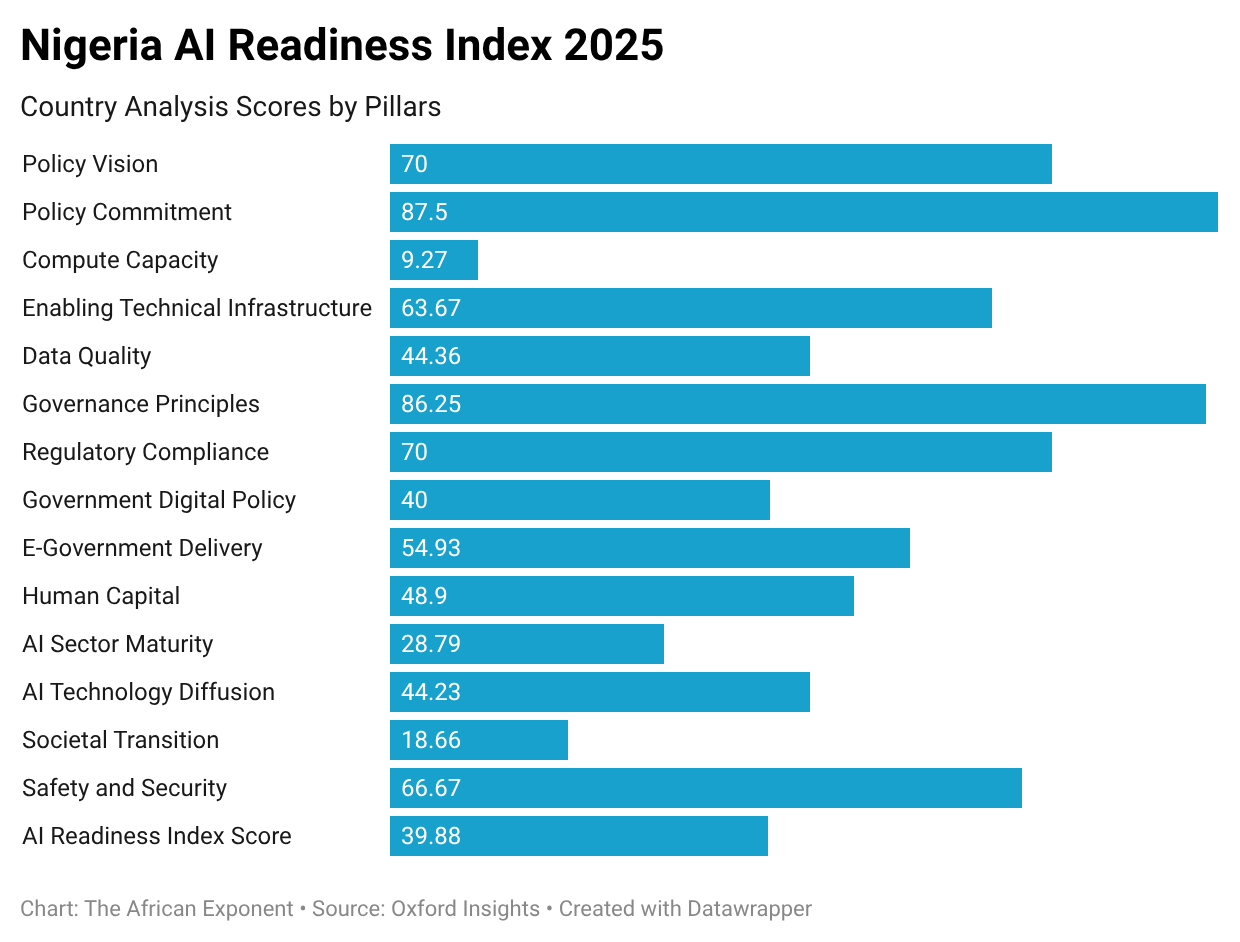
According to the Africa AI Readiness Index 2025, Nigeria has a societal transition score of 18.66, the lowest score among African countries and far below peers standout countries Côte d’Ivoire (48.39), Kenya (41.48), and Rwanda (44.57).
Some African markets provide clear examples of why the transition to AI is expected to be smooth. In Rwanda, government-led digitalisation has embedded technology into public services through platforms such as IremboGov, which enables citizens to access more than 100 services online, including business registration and civil documentation, supported by nationwide 4G infrastructure.
Côte d’Ivoire is another example, with mobile operators such as Orange Côte d’Ivoire and MTN Côte d’Ivoire rapidly expanded 4G coverage and mobile money platforms, enabling millions of users and small businesses to make payments, receive remittances, and access financial services through mobile wallets, which helped increase mobile money penetration from 109% to 261% between 2013 to 2023, according to the GSMA.
Nigeria, by contrast, has strong innovation capacity but weaker technology distribution across its broader population, meaning its AI ecosystem is advancing faster than societal adoption can keep up. One clear example is the gap between startup innovation and digital access. Nigeria hosts several globally recognised tech companies such as Flutterwave and Paystack, yet internet penetration remained at 44.43%, according to reports, meaning tens of millions of Nigerians still lack reliable internet access, limiting the widespread use of digital and AI-driven services.
Nigeria’s low societal transition score stems primarily from infrastructure/device gaps and economic limitations among the population, rather than a lack of developer talent or policy ambition.
The mobile broadband footprint in the country continues to expand, but access to the devices required to participate in the digital economy remains uneven. Smartphone penetration in urban areas has approached 59%, while adoption in rural areas is only about 26%. The disparity becomes more significant when viewed against population distribution. Roughly 45–50% of Nigeria’s more than 220 million people live in rural areas, meaning that well over 70 million rural Nigerians likely do not own a smartphone. In practice, this means tens of millions of citizens remain structurally excluded from the app-based digital services like mobile banking, online marketplaces, digital education tools, and AI-powered platforms that increasingly define the country’s technology economy.
This device gap highlights a deeper structural challenge: AI adoption ultimately depends on widespread digital participation. While Nigeria has a growing pool of developers and AI startups, the benefits of these technologies cannot diffuse across the economy if a large share of the population cannot access the internet through capable devices. Smartphone affordability, data costs, and digital literacy therefore become as important as infrastructure investments in determining how quickly AI-enabled services reach mass-market users. Without targeted policies or private-sector strategies to close this access gap, Nigeria risks developing a sophisticated AI ecosystem that primarily serves urban consumers and corporate clients while leaving a substantial portion of the population outside the digital economy.
Income distribution also plays a critical role. World Bank data shows that poverty and inequality remain persistent across large parts of Nigeria, limiting the ability of many households to participate in the digital economy even when infrastructure exists.
Does Nigeria’s Strong AI Sector Maturity Score Point to a B2B Opportunity?
Absolutely. According to the Africa AI Readiness Index 2025, Nigeria’s AI sector maturity score is 28.79, the second-highest in Africa, reflecting a robust ecosystem of developer talent, research initiatives, and enterprise interest. As of early 2026, Nigeria hosts over 120 AI startups, including players in fintech, logistics, and healthtech, demonstrating a vibrant innovation landscape even if broad societal adoption lags.
This maturity creates a clear B2B and enterprise opportunity. Unlike consumer-facing AI, enterprise applications rely on institutional connectivity and corporate infrastructure rather than mass smartphone penetration. Nigerian businesses and government agencies are already deploying AI for predictive analytics in supply chains, intelligent financial services automation, and infrastructure management. Moreover, Nigeria ranks 5th in Africa on the Global Government AI Readiness Index, signaling strong policy frameworks and institutional adoption that further support enterprise-focused AI use cases.
What Should Investors Watch Out for?
Nigeria’s AI ecosystem remains one of the most dynamic on the continent, supported by strong policy frameworks, deep entrepreneurial talent, and an active venture capital ecosystem. Yet the country’s low societal transition score highlights a structural constraint: the broader population is not yet adopting digital technologies at the same pace as the innovation sector.
For investors, the key takeaway is that sector maturity has not yet translated into mass-market adoption. Investment strategies must therefore distinguish between markets where digital adoption is already widespread and those where it remains concentrated in urban hubs.
In the near term, enterprise AI and B2B solutions may offer the fastest path to scale, while consumer platforms are likely to expand outward from digitally connected cities such as Lagos before achieving nationwide reach.
Ultimately, the trajectory of Nigeria’s digital economy will depend on whether improvements in connectivity, device affordability, and digital literacy can narrow the societal transition gap over the coming decade.
For now, Nigeria remains a paradox: a country with one of Africa’s most sophisticated AI ecosystems, but a population that is still catching up to the technology it is helping build.