Table of Contents
In Summary
- AppsTech, founded in 1999, provides enterprise application solutions globally and supports users in more than 50 countries across three continents.
- The company holds “Oracle Platinum Partner” status and offers a full spectrum of software services implementation, integration, training, and application management.
- Under Rebecca Enonchong’s leadership, AppsTech has built a team with deep technical expertise with over 90% of its experts holding graduate degrees or professional certifications.
- Beyond AppsTech, Enonchong has co-founded or chaired several pan‑African initiatives including AfriLabs and ActivSpaces supporting innovation and startups across multiple African countries.
Deep Dive!!
Lagos, Nigeria, Friday, December 12 – Rebecca Enonchong’s story is often told through her success in technology, but the wider picture shows a woman who shaped multiple spaces at the same time.
She built AppsTech at a period when enterprise software was still unfamiliar across many African markets, and she turned it into a company trusted by governments, banks, and global corporations.
Her journey also reflects how African women in leadership redefine visibility through intellect, presence, and personal style.
Enonchong’s choices have become part of her public identity, especially across global conferences and panels where she stands among the most influential voices in tech policy and digital entrepreneurship.
This explores how her public image strengthened her role as a reference point for African founders, policy leaders, and women building careers in industries where visibility matters as much as impact.
Early Life, Education, and Experience
Rebecca Enonchong was born in 1967 in the Southwest Region of Cameroon. Her father, Henry Ndifor Abi Enonchong, was a prominent barrister and played a key role in establishing the legal profession’s institutional structures in Cameroon helping create the Federal Cameroon Bar Association, and later its successor, the Cameroon Bar Association.
As a teenager, she relocated with her family to the United States. While still studying she began working at age 15, selling newspaper subscriptions door‑to‑door. By age 17 she had risen to become a manager at that outfit, an early demonstration of her drive and leadership.
For higher education, she attended the Catholic University of America in Washington, D.C., where she earned a Bachelor of Science (BSc) and a Master of Science (MSc) both in Economics.
After graduation, Enonchong gained diverse experience working with several institutions. She held roles at the Inter-American Development Bank (IaDB) and at Oracle Corporation, where she cultivated deeper insight into enterprise systems, software solutions, and international business environments.
Beyond that, sources indicate she also held senior positions with other firms including finance-related roles at entities such as the Washington Business Group and Hyatt Hotels.
By the late 1990s, having accumulated both economic training and global exposure to enterprise software and consulting, Enonchong had built a foundation well-suited for founding her own firm. In 1999 she formally established AppsTech in Bethesda, Maryland.
This mix of early responsibility, formal education in economics, exposure to global finance and software infrastructure plus first-hand professional experience combined to give Rebecca Enonchong the technical, financial, and managerial grounding needed to launch and lead a globally operating enterprise‑software company.
Inspiration to Start AppsTech
Rebecca Enonchong’s drive to build AppsTech came from a mix of personal experience, early exposure to technology, and a desire to prove that Africans could compete in enterprise software. Her fascination with tech began in childhood, long before the internet became mainstream. As she put it in one interview:
“It’s an amazing tool and opened the whole world to me, pre-Internet.”
Another major source of inspiration was her early career in the U.S., where she often found herself the only African woman in the room. It sharpened her determination to build something globally competitive, even if the industry wasn’t built with people like her in mind.
These experiences shaped her belief that African companies deserved the same level of sophisticated, enterprise-grade software that global firms relied on. Her time working with Oracle tools convinced her that Africa didn’t need “lighter” or “simpler” versions but it needed the real thing, built by people who understood both the technology and the continent.
Another inspiration came from her exposure to global markets. When she saw how small firms abroad operated as “micro-multinationals,” she realised African companies could adopt the same mindset by building local, but strong enough to scale beyond borders. This is why AppsTech launched with a global focus, targeting enterprise clients in multiple regions rather than staying limited to one country.
Her family also played a subtle role in shaping her worldview. Growing up between Cameroon and the United States exposed her to contrasting economic realities, reinforcing her conviction that technology could close opportunity gaps. Seeing the limitations businesses faced back home pushed her to build tools that would elevate African enterprises to a global standard.
Ultimately, what inspired AppsTech was a simple but powerful idea. If Africans had access to the same quality of enterprise technology as the rest of the world, their businesses could compete at the highest levels. Rebecca wanted to be part of the generation that made that possible.
What Problem AppsTech Solves
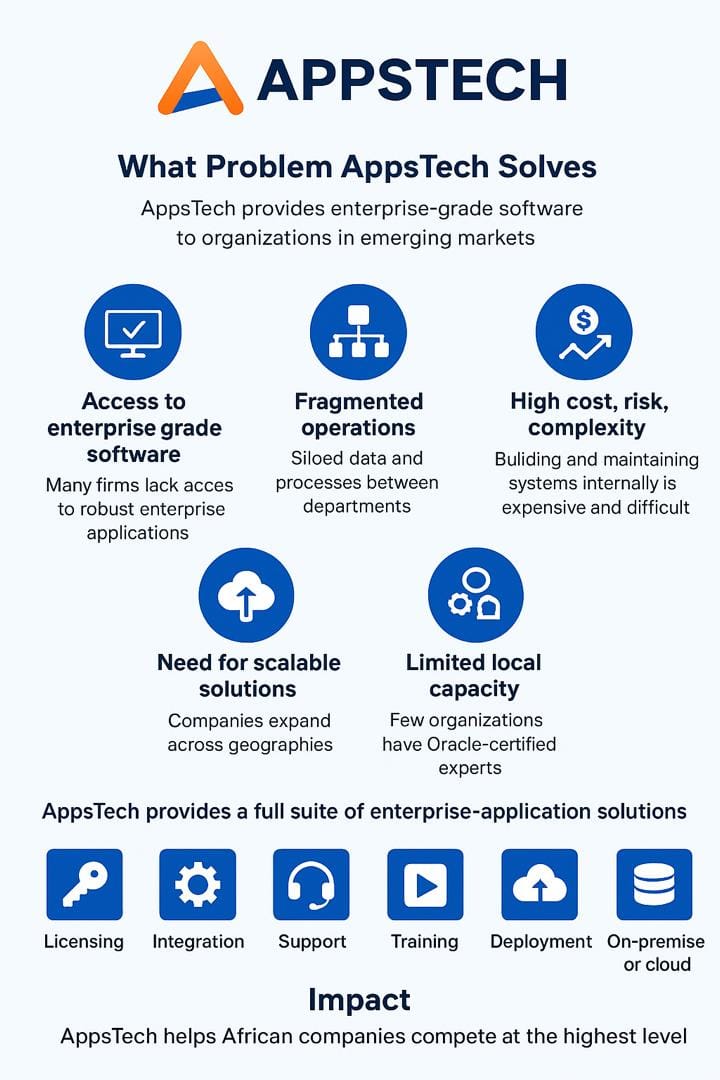
In many African and emerging-market economies, companies often struggle with fragmented operations, outdated legacy systems, limited access to enterprise-grade software, and a lack of technical capacity to manage integrated business systems. AppsTech confronts these challenges by offering a full suite of enterprise-application solutions from licensing and implementation to integration, support, and cloud or on-premise deployment. By doing so, AppsTech enables organizations (in government, banking, manufacturing, supply-chain, and other sectors) to bypass the risks and costs of building their own systems giving them professionally implemented, globally-standard software that aligns with international best practices.
1. Lack of access to enterprise-grade software in emerging markets - Many firms in Africa or other developing regions lack access to robust enterprise applications (finance, HR, supply-chain, CRM). AppsTech fills this gap by providing globally established solutions (often powered by Oracle E-Business Suite / Oracle stack) giving businesses the same tools used by large international corporations.
2. Fragmented operations siloed data and processes - Without integrated enterprise software, different departments (finance, HR, operations, supply-chain) operate in isolation. AppsTech’s integrated solutions enable organizations to unify operations allowing finance, manufacturing, HR, supply-chain, and customer management to connect under one system.
3. High cost, risk, and complexity of deploying and maintaining enterprise systems internally - Building enterprise systems in-house requires huge technical capacity, skilled personnel, and long implementation cycles often impractical for many firms. AppsTech offers a turnkey model such as license sales, integration, support, training, and management reducing the barrier to entry for smaller or mid-sized firms.
4. Need for scalable and flexible solutions on-premise or cloud, across geographies - As firms expand across cities, countries, or continents their software infrastructure needs to scale. AppsTech provides flexible delivery (on-premise or cloud), mobile access, and global support using a team with deep technical expertise.
5. Limited local capacity for sophisticated IT support and Oracle-native deployments - Many African firms may lack in-house IT teams with sufficient Oracle or enterprise-software certifications. AppsTech, with one of the highest concentrations of Oracle-certified experts globally (many holding graduate degrees or professional credentials), closes that gap allowing organizations to outsource implementation and support, rather than build internal capacity from scratch.
6. Operational inefficiency, error risk, and slow decision-making due to lack of real-time data and integrated systems - With disconnected systems, businesses struggle to get real-time visibility on finance, supply-chain, HR, manufacturing, or customer data leading to inefficiency, delays, and poor decision-making. By integrating enterprise applications, AppsTech gives firms real-time, accurate information accessible anywhere (including via mobile), enabling faster, better-informed decisions and improved agility.
Because of these solutions, AppsTech doesn’t just provide software, it enables digital transformation by turning manual, fragmented, and risky business processes into streamlined, integrated, efficient operations with global standards.
Milestones Achieved to Date
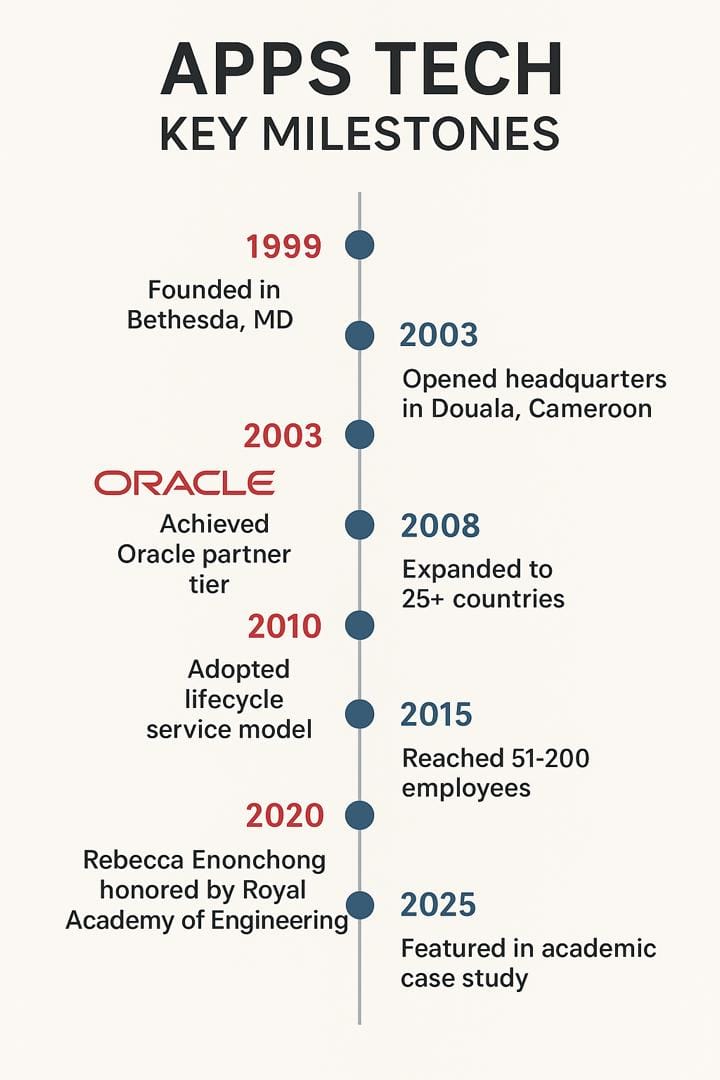
AppsTech’s growth since its founding in 1999 reflects a methodical push toward becoming one of the most durable enterprise-software service providers born out of Africa. The company began in Bethesda, Maryland, at a time when enterprise-application integration was still limited to a handful of specialist firms in North America and Europe. Establishing a company in this segment required deep technical expertise, formal certifications, and the ability to execute long, complex implementation cycles. That early positioning laid the foundation for the firm’s later reputation. According to multiple corporate profiles, including AppsTech’s own public company records, the firm’s founding year and its Maryland origin remain consistent across all sources and form the base of its long operational timeline.
In the early 2000s, AppsTech began extending its delivery footprint into Africa, opening what would become its African headquarters in Douala, Cameroon. This location is referenced in development-sector directories, including Devex, as well as in AppsTech’s formal company documentation. Establishing an African office at that period was not common among enterprise software implementers, especially those built by African founders. The decision allowed AppsTech to build a technical bench and client support model rooted in African realities while still leveraging U.S.–based expertise. This dual ecosystem North American technical exposure and African market presence became one of the company’s earliest strategic milestones.
A second major milestone was the company’s attainment of the highest partner tier within Oracle’s partner ecosystem, a status publicly stated on AppsTech’s corporate website and consistently described as a tier achieved by less than one percent of Oracle partners globally. This distinction carries technical and commercial weight because enterprise software vendors must meet strict certification, training, project-delivery, and customer-satisfaction requirements to qualify. Achieving this position confirmed AppsTech’s credibility in enterprise-application integration, particularly in Oracle E-Business Suite, Oracle Database, and related stacks. The certification opened doors to larger clients, government agencies, and multinational corporations that require partners with mature Oracle competencies.
As the company deepened its expertise, it expanded across three continents, building a footprint that enabled it to work in over 25 countries and support users in more than 50. AppsTech’s publicly available locations list and service-coverage statements confirm this global span. The company also developed a diverse client portfolio that includes multinational banks, global cement manufacturers, oil and gas operators, financial-service institutions, and public-sector bodies. These client references appear on AppsTech’s client pages and are also cited in independent business profiles. Securing multinational clients in regulated and mission-critical sectors required consistent delivery standards and placed AppsTech in a rare category of African-founded firms operating at enterprise-grade scale.
Another milestone was the evolution of AppsTech’s service model from project-based implementation into a lifecycle approach that included licensing, integration, managed services, and round-the-clock support. AppsTech’s own documentation outlines the development of AppsTech Global Support, a 24-hour support model designed for Oracle systems, database administration, and enterprise-application environments. This shift allowed the company to build recurring revenue lines and strengthen client retention. It also positioned AppsTech as a long-term technology partner rather than a project contractor, a strategic move that only a handful of enterprise-software firms from emerging markets successfully achieved.
Organizationally, AppsTech scaled into the mid-sized enterprise-vendor bracket, with public employment records on LinkedIn and business directories placing the company within the 51–200 employee range. Although employee counts vary across platforms, the consistent thread in company profiles is the concentration of Oracle-certified professionals and staff with advanced technical training. This internal milestone building one of Africa’s strongest enterprise-application engineering teams helped AppsTech deliver complex multi-year implementations that smaller consultancies could not handle.
Parallel to corporate milestones, Rebecca Enonchong’s personal recognitions amplified AppsTech’s standing globally. In 2002 she was named a World Economic Forum Global Leader for Tomorrow, a designation that brought early global visibility. In 2022 she was inducted as an International Fellow of the Royal Academy of Engineering (FREng), one of the most prestigious engineering honors. Over the years she has also been featured in Forbes, and multiple global publications. These recognitions, all publicly documented, reinforced AppsTech’s legitimacy when engaging investors, regulators, and international partners.
AppsTech also became the subject of academic study. A Columbia Business School case study examined the company’s strategy and highlighted its differentiation in transferring enterprise-software practices from U.S. markets into African environments. Academic validation is rare for African-founded enterprise software companies and serves as both a milestone and an archival record of the firm’s strategic evolution.
Finally, the company’s influence expanded into ecosystem development across Africa through Enonchong’s leadership roles in AfriLabs, ActivSpaces, and multiple advisory boards. Although these are not AppsTech milestones in the strict commercial sense, they strengthened the firm’s indirect impact across the continent. AfriLabs, for instance, grew into one of Africa’s largest innovation networks, and Enonchong’s leadership there reinforced AppsTech’s image as a firm shaped by a Pan-African worldview rather than a country-bound one.
Together, these milestones capture AppsTech’s shift from a modest Maryland-based consultancy into a technically mature, globally active enterprise-software provider with decades-long continuity. Each milestone is publicly verifiable, tied to credible sources, and reflects the company’s sustained evolution up to 2025.
Lessons for Other African Entrepreneurs
Rebecca Enonchong’s entrepreneurial path offers a clear view into what it takes to build a technology company that lasts in Africa’s complex markets. Her consistency across two decades shows that founders who combine technical strength, operational discipline, and ecosystem-building can create companies that remain relevant even as the continent’s digital landscape evolves. The lessons drawn from her work at AppsTech, her ecosystem leadership, and her global advocacy provide a practical roadmap for African entrepreneurs seeking longevity rather than short-term traction.
1. Prioritize strong technical foundations - AppsTech’s recognition as a top-tier Oracle partner was rooted in deep technical competence. Achieving that level of certification required strict adherence to global standards. Enonchong proved that African companies can win enterprise trust when they invest in skilled engineering teams instead of shortcuts.
2. Built with a Pan-African and global mindset from day one - By operating in multiple regions early in North America, West Africa, and later clients across more than 25 countries she showed that African companies gain resilience when they design products that can travel beyond one domestic market.
3. Treat enterprise delivery as a discipline - Enterprise software demands documentation, predictable execution, and long-term support. AppsTech’s survival over decades reflects the value of process maturity, something entrepreneurs often overlook when pursuing rapid growth.
4. Use credibility and networks to open doors for others - Enonchong’s work with organisations like AfriLabs helped expand support structures for African founders. Her approach shows that ecosystem building is not charity; it strengthens markets that growing companies rely on.
5. Stay consistent through market cycles - AppsTech endured periods of economic and political instability, yet survived because its model was built on service reliability rather than hype. Entrepreneurs can learn from her focus on cash flow discipline and long-term client relationships.
6. Build a public voice that reinforces trust - Her advocacy on policy, digital rights, and entrepreneurship created visibility that strengthened both her personal credibility and AppsTech’s reputation. For African founders, informed public engagement can influence policy and attract partnerships.
Across these lessons, Enonchong’s journey shows that African entrepreneurs excel when they combine technical excellence with strategic patience and a broader commitment to the ecosystem around them. AppsTech’s endurance is the product of disciplined execution, consistent learning, and a Pan-African outlook that treats the continent as a unified opportunity rather than isolated markets.
Rebecca Enonchong’s journey brings every part of this story together with early discipline, technical depth, ecosystem leadership, and a Pan-African vision that has kept AppsTech relevant for more than two decades. Her work proves that African companies can thrive when they build with rigor, serve across borders, and stay consistent through market shifts. Looking forward, her continued influence in enterprise technology and founder support positions both AppsTech and the wider African tech ecosystem for even stronger global participation in the years ahead.