Table of Contents
In 1961, British economist James Meade arrived in Mauritius and saw an economy running out of room. The island had fewer than 700,000 people, depended almost entirely on sugar, and produced little beyond what it consumed. In Meade’s assessment, Mauritius was trapped by its own demography and geography. With too many people and too few productive sectors, meaningful development would be “very limited,” if it came at all.
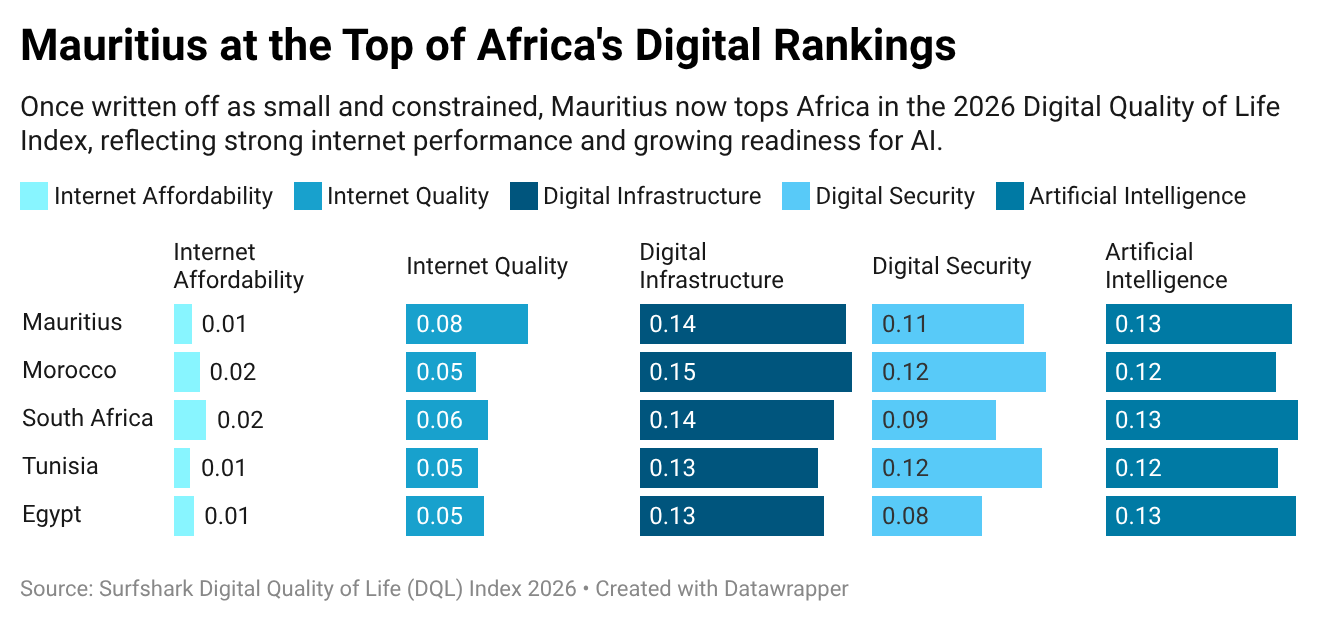
Six decades later, that forecast has been overturned. Mauritius now ranks first in Africa on the Digital Quality of Life Index, outperforming countries many times its size and resource base. It places ahead of Egypt, home to more than 80 million internet users, South Africa, with its globally integrated telecom firms, and other North African economies such as Morocco and Tunisia. Internet penetration exceeds 90 percent, public services are increasingly delivered through digital platforms, and a dense web of submarine cables connects the island directly to Africa, Asia, and Europe.
The result is not simply faster internet or better online services. It is a digital environment that supports daily life, commerce, and government at a level unmatched elsewhere on the continent. By the metrics that matter, access, stability, speed, and usability, Mauritius has become Africa’s reference point.
The question, therefore, is not whether Mauritius leads. The data already settles that. The more difficult question is how a small volcanic island in the Indian Ocean, with no oil, no strategic minerals, and a population smaller than many global cities, built a digital system that larger and richer countries have struggled to replicate.
How has Mauritius kept reinventing its economy for over five decades?
Mauritius’ digital leadership did not emerge in isolation. It is the most recent phase in a long-standing pattern of economic reinvention, one that has shaped the island’s development strategy since independence.
When Mauritius gained independence from Britain in 1968, its economy was structurally narrow and exposed. The economy relied heavily on sugar, which contributed nearly a quarter of GDP and accounted for most export earnings.
The colonial system had left the island dependent on a single crop, a limited set of trading partners, and an economic model with little room for expansion.
Rather than entrench this structure, the Mauritian state chose to dismantle it. In 1970, the government enacted the Export Processing Zones Act, creating a parallel industrial system designed specifically for export manufacturing. The policy combined tax incentives, duty-free imports, and simplified regulations, lowering barriers for foreign firms while preserving domestic stability. Manufacturers from Hong Kong and Taiwan responded quickly, drawn by predictable rules and a workforce that could be trained at scale.
By the mid-1980s, textiles had overtaken sugar as the island’s primary export sector. By 2000, manufacturing accounted for the majority of merchandise exports, fundamentally reshaping the economy. Just as importantly, the state used the proceeds from this shift to fund education, healthcare, and institutional capacity, laying the groundwork for future transitions.
As global competition intensified and low-cost producers in Asia eroded Mauritius’s textile advantage, the island pivoted again. Tourism and financial services expanded through the 1990s and 2000s, supported by regulatory reform, infrastructure investment, and an English-speaking workforce. The formula remained consistent. The government defined the direction, reduced friction, and invested ahead of demand. The private sector operates within that framework.
Digital transformation represents the fourth iteration of this approach. Like textiles and financial services before it, the digital economy required long-term planning, upfront investment, and confidence in human capital. Crucially, it also benefited from what earlier phases had already built: institutional coordination, policy discipline, and a workforce accustomed to economic change.
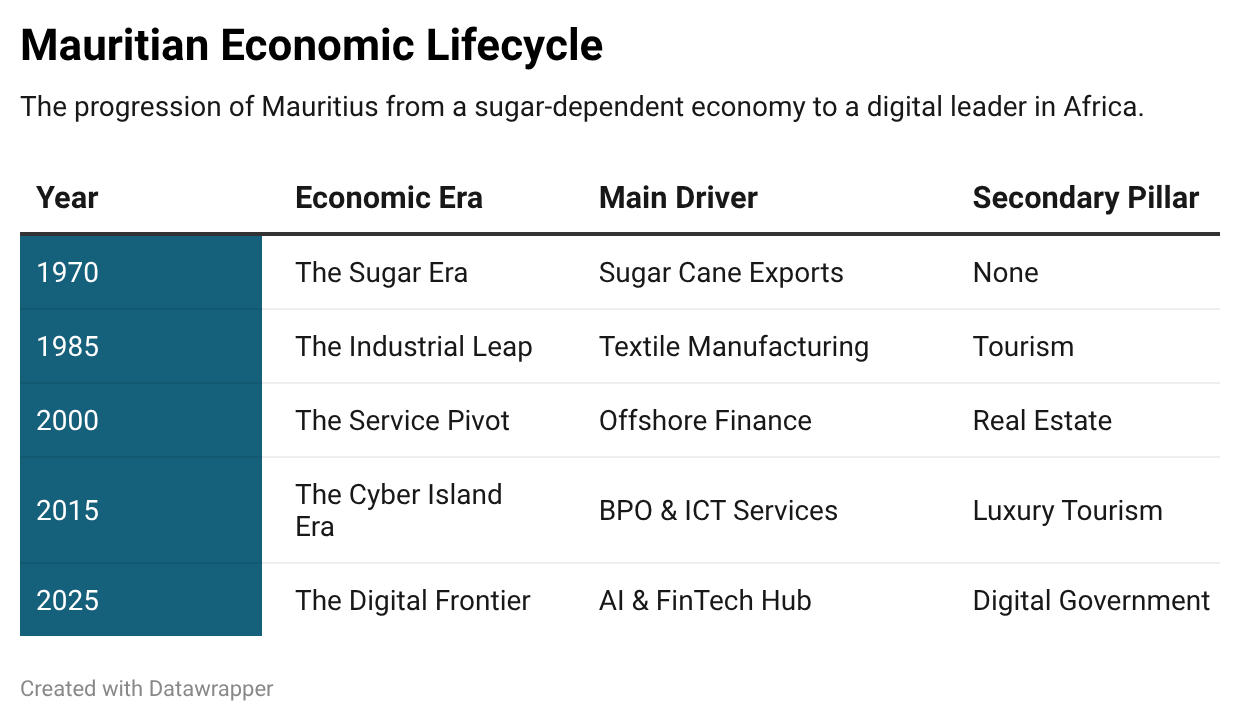
Mauritius’s rise in digital quality of life is therefore not an accident of technology or timing. It is the outcome of a development model that treats reinvention as a continuous process rather than a one-time reform.
Why did Mauritius build a global-scale digital infrastructure for a small population?
Mauritius’s digital leadership rests on deliberate, long-term infrastructure investment. Its main telecom operator, Mauritius Telecom, deployed submarine cables, fiber networks, and data centers well ahead of domestic demand, positioning the island not just as a national network but as a potential intercontinental hub linking Africa, Asia, and Europe.
Mauritius Telecom operates and partners in multiple submarine cable systems, including SAFE (2002), LION (2009), METISS (2021), and T3, which landed in 2023 with a design capacity of 72 terabits per second, far exceeding the needs of a population of 1.3 million.
The company is now developing T4, a $150–200 million cable connecting Mauritius to India and Singapore, intended to replace the aging SAFE system and expand capacity. This project forms part of a $434 million three-year investment roadmap covering expanded fiber coverage, 5G-Advanced networks, GPU clusters for AI workloads, and Tier IV data center expansion.
Mauritius’s fiber-to-the-home coverage ranks among the top ten globally, while 5G networks operate in major cities and business districts, supporting fintech, cloud computing, and AI-driven applications.
Strategic location amplifies these investments. Situated roughly equidistant from Johannesburg, Mumbai, and Singapore, Mauritius can support transcontinental data traffic, host edge infrastructure, and serve regional businesses. The guiding principle is clear: invest ahead of demand and build capacity for future growth.
What makes Mauritius’s digital strategy different from the rest of Africa’s?
Infrastructure alone does not explain Mauritius’s digital leadership. Several African countries have invested heavily in fiber networks, data centers, and international cables. What distinguishes Mauritius is not the presence of infrastructure, but the way policy, institutions, and execution are aligned around it.
In May 2025, the Mauritian government formalised this alignment with the launch of A Blueprint for Mauritius: A Bridge to the Future, a national digital transformation strategy developed in collaboration with UNDP Mauritius. Unlike many digital strategies on the continent, the Blueprint is not framed as an aspirational vision document. It is a systems plan, explicitly designed to coordinate infrastructure, skills, regulation, and service delivery across government and the private sector.
Presenting the Blueprint, Minister of Information Technology, Communication and Innovation, Dr. Avinash Ramtohul, outlined its structure in concrete terms:
“The Blueprint is built around four fundamental pillars: the establishment of a state-of-the-art info-structure…the development of human capital… the promotion of innovation and private sector growth…and the creation of a sustainable and resilient digital future.”
Those pillars translate into operational commitments. The state committed to a unified government services portal with single sign-on, mobile digital identity for authentication and document signing, regulatory frameworks for satellite broadband and e-commerce, and the creation of a dedicated artificial intelligence unit within the Ministry. Cybersecurity standards for telecom operators and public platforms were set as baseline requirements.
Mauritius paired these commitments with institutional ownership. Each component of the Blueprint was assigned to an implementing body with defined authority. The Digital Transformation Bureau oversees e-government rollout, the National Computer Board manages cybersecurity governance, and the Data Management Office oversees the national citizen data hub. Budget allocations in the 2025–26 fiscal year ensured implementation moved forward.
Government officials have been explicit that the objective is not digitisation for its own sake. That emphasis on inclusion runs through the policy framework. The Blueprint explicitly adopts a Public–Private–and People Partnership model, recognising that digital transformation cannot be delivered by the state alone. The scope of this ambition is national, not confined to the main island. Digital inclusion initiatives extend to Rodrigues, where connectivity and service access have historically lagged. As the Ministry noted in outlining its regional strategy:
“We are building a digital future where every Rodriguan has access, opportunity, and a voice.”
At the highest level of the state, the Blueprint is framed as a long-term development instrument rather than a sectoral reform. At its launch, President Dharambeer Gokhool described it as a turning point in national planning:
“The launch of this Digital Transformation Blueprint 2025–2029 is a defining moment in the history of our Republic - a moment that sets the tone for the future we seek to build: inclusive, innovative, resilient, environmentally sustainable, and distinctly Mauritian.”
What emerges from this architecture is not policy volume, but policy coherence. Infrastructure investments by Mauritius Telecom align with regulatory timelines. Skills development initiatives correspond to anticipated demand in AI, cybersecurity, and cloud services. Agencies are structured to reduce overlap rather than compete for mandates.
This coordination helps explain why Mauritius’s digital initiatives tend to move from announcement to deployment faster than in many peer countries. The system is designed to convert strategy into execution, and execution into lived outcomes.
Why was Mauritius’s workforce already prepared for the digital shift?
Mauritius’s digital success rests on decades of investment in human capital. The government recognized early that infrastructure alone would not create a digital economy without a workforce able to use and manage it.
During the textile boom of the 1970s and 1980s, revenue from sugar and manufacturing was deliberately directed toward education, healthcare, and institutional capacity rather than subsidies or prestige projects. By 2007, net primary school enrollment had reached 96 percent, compared with 74 percent across sub-Saharan Africa. This focus on literacy and numeracy created a workforce ready for subsequent industrial transitions.
When Mauritius pivoted to financial services and tourism in the 1990s and 2000s, English-speaking, digitally literate workers were immediately deployable. Today, that same pipeline fuels the island’s digital economy, supplying coders, analysts, and technology specialists capable of supporting AI, fintech, and cloud-based services.
Current initiatives continue this tradition. Government programs provide training in AI, data analysis, cybersecurity, and digital literacy. Universities offer ICT degrees aligned with industry needs, while private coding bootcamps and startup incubators supplement public programs, ensuring a steady flow of skilled talent for emerging digital sectors.
Mauritius Telecom’s leadership explicitly frames talent as central to its strategic ambitions. CEO Veemal Gungadin explained:
“This initiative aligns with Mauritius Telecom’s mandate to promote AI talent and innovation… The Corridor positions Mauritius not just as a consumer of digital innovation but as a producer and host of advanced digital capabilities, supporting enterprises, governments, and innovators across the region.”
He further emphasizes the broader role of digital skills in national development:
“At Mauritius Telecom, we reaffirm our commitment to putting our expertise at the service of the country. This strategic partnership with SIL embodies our determination to support the State in implementing high‑impact digital transformation projects, aligned with national priorities.”
The impact of these investments is measurable. The International Telecommunication Union (ITU) 2025 rankings place Mauritius third in Africa for ICT development, with a score of 86.3. The country holds a Tier 1 cybersecurity rating, the highest classification reflecting both robust infrastructure and a workforce capable of operating it effectively.
By aligning education, digital training, and industry demand, Mauritius created a cycle where talent and infrastructure reinforce each other.
What the rankings don’t capture about Mauritius’s digital reality
Mauritius’s position at the top of Africa’s digital rankings is impressive, but it does not mean the island has solved every challenge in connectivity and digital services. The Digital Quality of Life Index reflects averages, which can mask gaps in accessibility, affordability, and usability.
Internet access is near-universal, yet the cost remains a barrier for lower-income households. Fixed broadband subscriptions, though available, are concentrated in urban areas, while rural communities, small as they are on the island,d may face slower connections or fewer service options.
The government’s e-services platforms are extensive, but usability and interoperability vary across agencies. Citizens sometimes encounter fragmented services or inconsistent interfaces when interacting with different departments.
Moreover, Mauritius’s small economy means that many digital services are imported rather than locally developed. Startups and domestic innovation are growing, but still limited compared with the scale of ICT infrastructure and international connectivity.
Mauritius shows what coordinated policy, infrastructure, and skills can achieve. But it also highlights ongoing challenges in affordability and local innovation realities that other African countries will also face when scaling digital economies.