
Table of Contents
Over the past decade, Rwanda has built one of Africa's most compelling tech narratives. The narrative is woven around the development of Kigali Innovation City and its nationwide fiber-optic coverage; as a result, the country has positioned itself as a future-ready digital hub. Kigali's startup ecosystem, anchored by spaces like Norrsken House Kigali, reinforces this image of a modern, connected, and investor-friendly tech hub.
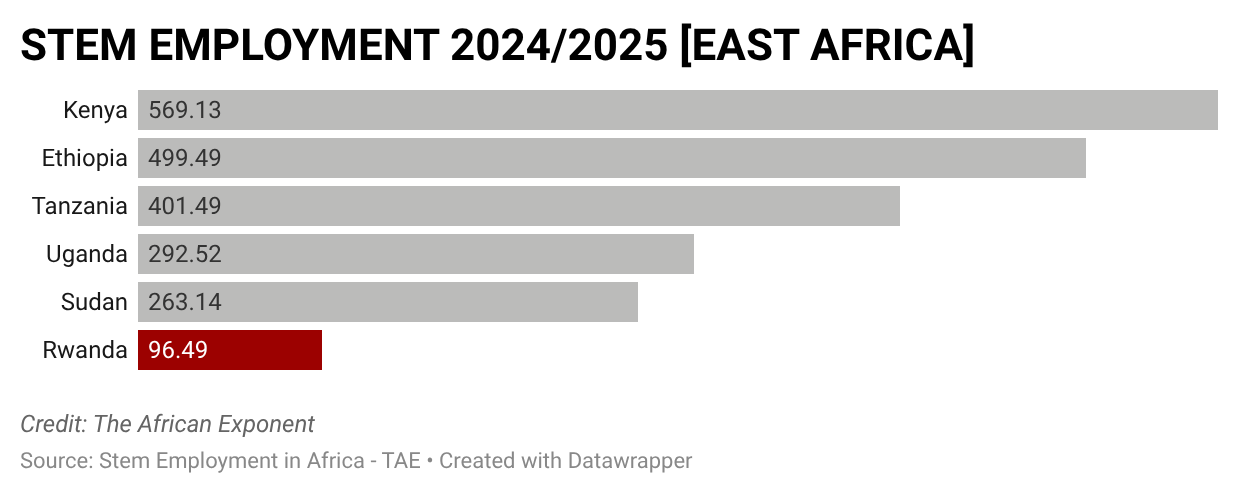
But the labour data tells a different story. According to the International Labour Organization's STEM employment database, Rwanda has just 96,493 STEM workers in total. Of these, 57% are absorbed into public-sector roles, primarily in health and defense. More strikingly, only 1,673 workers, accounting for about 1.7%, are in programming-related roles.
The contrast is sharp and a cause for concern for many prospective investors trying to make informed decisions. While Kigali's tech hubs project the image of a growing digital economy, the reality is that experienced software engineers remain statistically rare. For an investor or operator, finding a senior Rwandan DevOps engineer is not only difficult, it is structurally constrained.
What is the Public Sector Vacuum affecting STEM Employment?
This imbalance is not accidental. Rwanda's development model has deliberately prioritized state-led capacity building, creating what can be described as a "public sector vacuum" in the private tech labour market.
Top graduates, particularly those emerging from institutions like the University of Rwanda and Carnegie Mellon University Africa in Kigali, are often funneled into government or government-aligned roles. This is partly by design: Rwanda's Presidential Scholars program channels many of its highest-performing engineering graduates into public institutions, where they are expected to contribute to national digital transformation priorities. The Rwanda Information Society Authority (RISA) alone accounts for a significant share of elite graduate absorption, offering structured career pathways that private firms struggle to replicate at the same stage.
Government-backed roles offer job security, predictable career paths, competitive compensation, and long-term security. The wage gap is measurable: according to survey data, mid-level engineers at local private firms earn approximately 1.74 million RWF per month on average, compared to roughly 4 million RWF for those placed with international employers, a 2.3x salary multiplier that defines the competitive landscape for talent acquisition. Government roles sit closer to the international end of that spectrum, further squeezing private-sector operators.
As a result, mid-level engineers frequently opt for public-sector roles first, forcing private firms to either overpay to compete or delay hiring, thereby effectively pushing up the wage floor for technical talent. This increases operating costs, compresses margins, and slows product development cycles, often forcing startups to scale more cautiously or rely on outsourced and diaspora talent to fill critical gaps.
What is the Reality of the Existing Private Tech Ecosystem in Rwanda?
For practitioners on the ground, the aforementioned landscape results in a "thin base" of available talent. The experience of Andela illustrates this dynamic. Originally known for training junior developers at scale, Andela has shifted its model toward connecting companies with more experienced, remote engineers. This pivot reflects a key gap in Rwanda's ecosystem: the shortage of mid-level developers with 5–8 years of experience who can lead teams.
This is not simply anecdotal. A survey conducted by the Rwanda Tech Association (RTA) in partnership with PwC found that 85% of firms cite skill gaps as a primary operational constraint, with 60% specifically reporting a shortage of AI and machine learning capacity. These figures give empirical weight to what the Rwanda ICT Chamber has long described as the "missing middle", i.e. the near-absence of engineers with enough seniority to bridge entry-level output and senior architectural work.
One regional platform that has emerged to address this gap is Umurava, a Rwanda-founded talent marketplace that connects East African engineers with international clients seeking cost-competitive, skilled remote labour. Umurava's model is a direct product of the talent arbitrage reality the data describes: local engineers capable enough to serve global employers, but priced out of the domestic private market by wage competition from the public sector and multinationals.
In practical terms, this shapes hiring strategies. A fintech company entering Kigali in 2026 and looking to hire 10 senior engineers would likely need to combine approaches: headhunting from government institutions, recruiting from multinational firms, and importing up to 40% of talent from the diaspora or other African markets. Notably, the East African Community's labour mobility framework allows skilled professionals from EAC member states to work across borders for up to six months without requiring a work permit, a provision that meaningfully lowers the logistical barrier to regional talent importation. For operators who need to move faster, Rwanda's Special Skills permit offers an expedited pathway, with processing times of approximately 48 hours for qualifying roles. That timeline makes importing senior talent a viable short-term option rather than a bureaucratic burden.
Is Rwanda Prioritizing Infrastructure Over Talent?
Rwanda has invested heavily in digital infrastructure, achieving some of the best connectivity on the continent. Yet with only 1,673 programmers, the question becomes: who is fully utilizing this infrastructure?
Compared to markets like Kenya or Nigeria, where private-sector tech ecosystems absorb a larger share of STEM talent, Rwanda's concentration in public administration is unusually high. The country has effectively built the physical and regulatory foundations of a digital economy faster than its human capital base can scale.
From a long-term perspective, this may reflect a deliberate "build stage." The government is prioritizing systems, governance, and infrastructure first, with the expectation that talent depth will follow; but that sequencing is not guaranteed to produce the outcomes investors need.
A practical example is seen in data infrastructure and fintech development in Kigali. Rwanda has nationwide 4G coverage and reliable fiber networks, enabling cloud-based services and digital payments. However, a startup building a mobile lending platform may still struggle to hire experienced backend engineers locally. In practice, the company ends up hosting its platform locally but outsourcing core development to engineers in Kenya or hiring from the diaspora, because the pool of experienced local programmers is limited. The infrastructure exists to support a scalable product, but the human capital required to fully utilize it is not yet deep enough; forcing firms to import talent rather than rely on the domestic market.
Where Does this Place Potential Investors?
For investors, Rwanda presents a clear but nuanced proposition. In the short term, talent constraints must be priced in. Hiring is not simply a function of demand; it requires deliberate capital allocation, and that cost is not abstract.
Rwanda's Digital Ambassadors Program (RDAP) offers one structured reference point. The program provides grants of between $50,000 and $100,000 to qualifying companies, tied to a specific model: a senior expatriate or diaspora hire brought in to mentor and develop a cohort of four junior local engineers. This mechanism gives operators a concrete frame for what "build-your-own" actually costs and what government co-investment looks like in practice. For investors modeling entry costs, the RDAP structure suggests that talent development is not only expected, it is partially subsidized when structured correctly.
For long-term investors, the outlook is more constructive. Rwanda's disciplined approach to governance and infrastructure suggests that the current 1.7% programming share is not static. As the Presidential Scholars pipeline matures, RISA expands its technical capacity, and private-sector demand creates competing incentives, the talent base is likely to broaden.
Rwanda in 2026 is a paradox. It is a regulatory haven with world-class digital infrastructure, but also a talent desert for specialized software engineering. The opportunity is real, but so is the constraint. For investors, success will depend less on accessing the market and more on building the talent needed to operate within it. The tools to do that exist. The question is whether operators are prepared to use them.