
Table of Contents
In Summary
- Sim Shagaya launched Konga in 2012 to address structural barriers limiting large-scale e-commerce adoption across African markets.
- Konga combined commerce, logistics, and payments to solve trust, delivery, and infrastructure gaps that had stalled earlier platforms.
- Beyond retail, Shagaya’s work helped shape how African digital businesses think about scale, local execution, and long-term infrastructure.
Deep Dive!!
Lagos, Nigeria, Tuesday, January 6, 2026 - Africa’s digital economy has often been discussed in terms of potential rather than execution. While internet access expanded rapidly across the continent in the early 2010s, large-scale digital commerce struggled to take hold. Weak logistics networks, limited trust in online payments, fragmented addressing systems, and low consumer confidence made e-commerce difficult to sustain beyond small experiments.
Sim Shagaya entered this landscape with a different thesis. Rather than treating e-commerce as a simple website-and-delivery problem, he approached it as an infrastructure challenge that required solving for payments, logistics, merchant trust, and consumer behavior simultaneously. In 2012, he founded Konga to build a commerce platform designed specifically for African realities, not imported assumptions.
Konga was never positioned as a Nigeria-only experiment. From its early structure, the company reflected a broader Pan-African ambition proving that digital marketplaces could operate at scale in environments where systems were fragmented and institutions uneven.
The company’s evolution offers a detailed case study in how African founders build under constraint, adapt global models to local conditions, and develop infrastructure capable of supporting continental growth.
This research examines Sim Shagaya’s journey with Konga within a wider African entrepreneurial narrative. It focuses on how experience, strategy, and execution converged to build one of the continent’s most influential early e-commerce platforms, and what that experience reveals about building durable digital businesses in Africa.
Early Life, Education, and Experience
Simdul Shagaya was born in 1975 in Lagos, Nigeria into a military family. His father, John Nanzip Shagaya, was a career officer in the Nigerian Army and later served as a senator representing Plateau Central in the Nigerian Senate. Growing up in a military household meant that Shagaya experienced frequent relocations across different parts of Nigeria during his childhood, instilling early discipline and exposure to diverse environments across the country.
Shagaya’s formal education began at the Nigerian Military School in Zaria, where he was trained under a regimented system that emphasized endurance, focus, and structure. Upon completing his secondary schooling, he served in the Nigerian Army for two years, a period he later described as formative even though he chose not to pursue a long-term military career.
After military service, Shagaya moved to the United States to further his academic training. He enrolled at the George Washington University in Washington, D.C., where he earned a Bachelor of Science in Electrical Engineering. This technical foundation helped shape his ability to understand and engage with digital platforms and technology from a systems perspective.
He then pursued graduate studies at Dartmouth College’s Thayer School of Engineering, where he obtained a Master of Science in Engineering Management. This degree bridged technical engineering skills with managerial and operational thinking, a combination particularly relevant for scaling technology ventures.
Seeking deeper business and strategic acumen, Shagaya completed a Master of Business Administration (MBA) at Harvard Business School in 2003. The MBA equipped him with advanced frameworks for corporate strategy, finance, and leadership skills that would become critical in his subsequent entrepreneurial endeavours.
Following his education, Shagaya’s early professional experience spanned investment banking, technology operations, and media entrepreneurship. He began his career in South Africa with Rand Merchant Bank, gaining experience in financial services and corporate structuring. He later moved to Nigeria and took on a leadership role at Google as Head of Africa, where he was responsible for advancing the company’s presence and operations across sub-Saharan markets in an era when internet adoption was still nascent.
Shagaya’s first entrepreneurial venture was E-Motion Outdoor Advertising, launched in Lagos in November 2005. The company grew to be a major out-of-home advertising business before being sold to Loatsad Promomedia in 2019, giving Shagaya both experience and capital for future ventures. Before Konga, he also experimented with several early internet platforms such as Alarena.com, Jobclan.com, Gbogbo.com, and iNollywood.com, which provided formative lessons even though they did not achieve lasting commercial success.
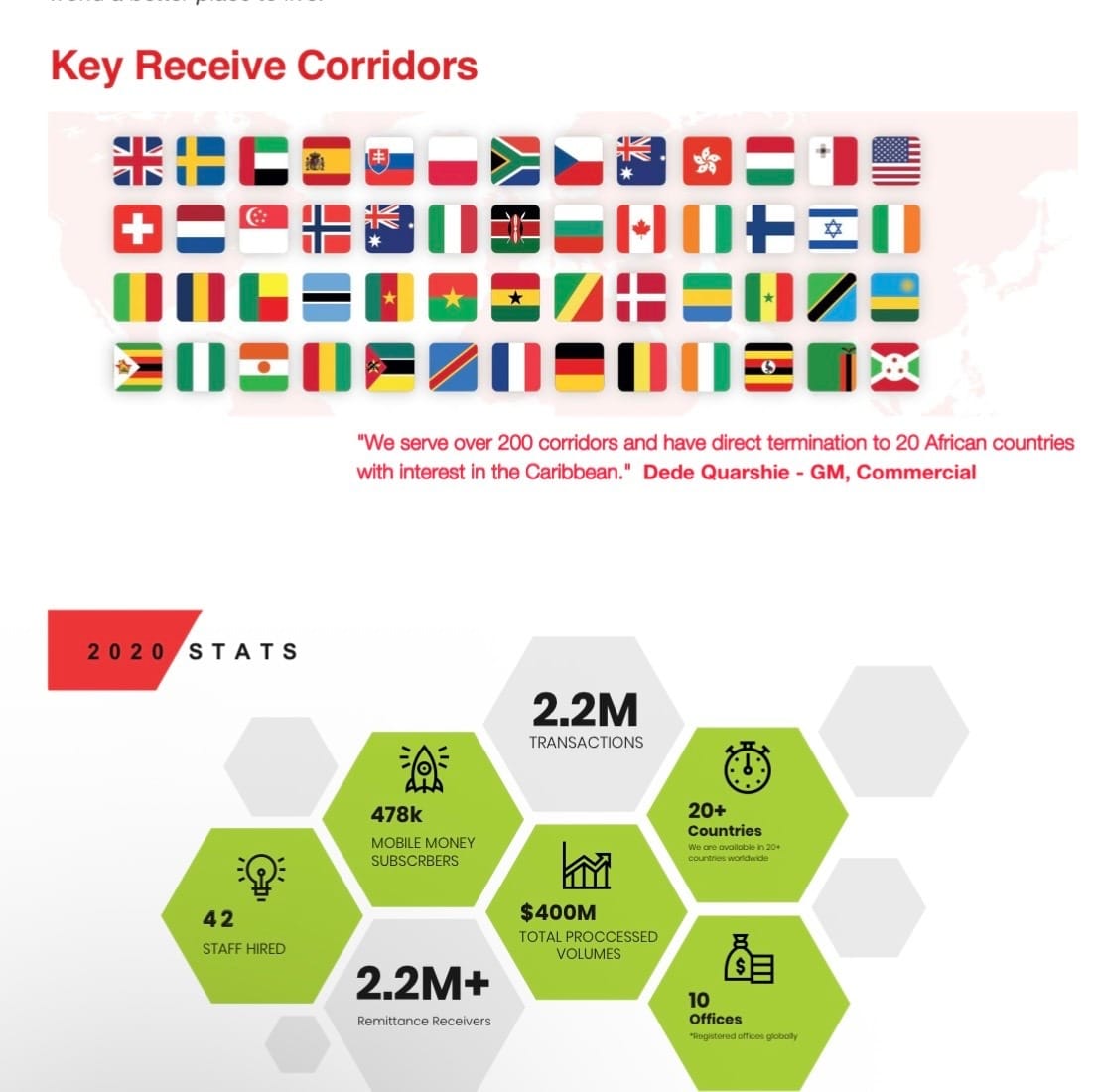
In 2011, Shagaya launched DealDey, a daily deals website, after convincing the board of E-Motion to back the initiative. This marked his first significant foray into digital commerce. The following year, in July 2012, he founded Konga.com, with capital from Swedish investor Kinnevik, setting the stage for what would become one of West Africa’s first major e-commerce platforms.
Inspiration to Start Konga
Sim Shagaya’s decision to start Konga was shaped less by retail ambition and more by structural observation. By the early 2010s, internet penetration across Africa was rising steadily, driven by cheaper smartphones, undersea cables, and mobile broadband expansion. Yet this connectivity had not translated into functional digital commerce at scale. Existing online retail attempts struggled with delivery failures, payment distrust, and low repeat usage. Shagaya saw a gap between digital access and digital utility.
Before Konga, Shagaya had already tested the limits of African internet businesses through several ventures, including DealDey, a daily deals platform launched in 2011. DealDey exposed him directly to the operational bottlenecks of online transactions in African cities. Customer acquisition was possible. Demand existed. The failure point was execution. Orders broke down at fulfillment. Cash-on-delivery introduced fraud and cancellations. Payments lacked reliability. Logistics operated without address standardization.
Rather than conclude that e-commerce could not work in Africa, Shagaya reached a different conclusion. The problem was not consumer readiness but infrastructure absence. In multiple interviews, he has explained that African markets required vertically integrated systems rather than thin platforms. Unlike mature markets where logistics firms, payment processors, and address systems already existed, African e-commerce founders had to build these layers themselves.
Konga was conceived in 2012 as a response to that insight. Shagaya’s vision was not a simple online storefront. It was a commerce system designed to function in fragmented environments. This meant building proprietary logistics operations, warehousing, delivery routing, and payment mechanisms capable of handling cash, cards, and transfers while gradually nudging users toward digital trust.
The inspiration was also shaped by a Pan-African lens. Shagaya has consistently argued that African startups fail when they import Western assumptions about consumer behavior and institutional strength. Konga was intentionally built around African constraints rather than despite them. The company’s early strategy prioritized operational control over speed, reliability over aggressive expansion, and trust-building over short-term scale metrics.
Investor conversations reinforced this approach. When Konga raised early funding from Kinnevik, the focus was not just growth projections but execution depth. The capital was meant to fund warehouses, delivery fleets, technology teams, and risk systems. These were cost-heavy investments that many earlier platforms avoided, often leading to collapse. Shagaya’s conviction was that commerce in Africa required patience and capital discipline, not just software.
At its core, Konga was inspired by a simple but radical premise for its time. If African consumers were given consistent delivery, transparent pricing, and dependable payments, they would adopt digital commerce at scale. The challenge was not demand creation but system construction. Konga became Shagaya’s attempt to prove that large-scale e-commerce could succeed in Africa when built as infrastructure rather than as a lightweight marketplace.
What Problem Konga Solves
Konga was designed to address multiple structural failures that had historically prevented e-commerce from scaling across African markets. These problems were infrastructural, institutional, and trust-related rather than demand-driven.
1. Weak Logistics and Last-Mile Delivery Infrastructure
E-commerce in Africa has long been constrained by unreliable delivery systems, poor address mapping, and limited third-party logistics capacity. These gaps resulted in failed deliveries and low repeat usage. Konga addressed this by investing directly in warehousing, fulfillment, and delivery coordination, allowing it to control critical parts of the supply chain rather than depend entirely on external providers.
2. Low Trust in Online Transactions
Consumer hesitation around online shopping was driven by fears of fraud, non-delivery, and poor product quality. Prepaid transactions were particularly difficult to scale. Konga mitigated this by supporting flexible payment options, including cash-on-delivery, while building structured return, refund, and customer service systems that improved transaction reliability and trust over time.
3. Fragmented and Unreliable Payment Systems
Digital payments across African markets have suffered from low interoperability and frequent transaction failures. Bank transfers and card payments were often inconsistent. Konga developed internal processes to manage multiple payment channels, handle reversals, and reconcile settlements, reducing friction for both buyers and sellers.
4. Limited Market Access for Small and Medium Merchants
Many African merchants lacked the infrastructure needed to sell beyond local markets. Konga’s marketplace model provided access to warehousing, logistics, and a national customer base, lowering barriers for small and medium sellers to participate in digital commerce.
5. Information Gaps and Price Opacity
Offline retail markets often suffer from inconsistent pricing and limited product information. Konga centralized listings, pricing, and product details, improving transparency for consumers while helping merchants understand demand and competition more clearly.
Milestones Achieved to Date
Konga launched in July 2012 in Lagos with a core retail model selling baby care, beauty, and personal products, quickly expanding its offerings to a full suite of consumer categories. In late 2012, the platform expanded nationwide across Nigeria, marking its first major scale milestone within six months of launch.
In early 2013, Konga completed its Series A funding round, raising $10 million from Investment AB Kinnevik and Napers, followed by a Series B raise of $25 million later that year, marking one of the largest startup investments in Africa at the time. In January 2014, the company introduced Konga Marketplace, opening the platform to third‑party sellers and enabling merchants to list products directly, eventually featuring over 8,000 merchants by the end of 2014.
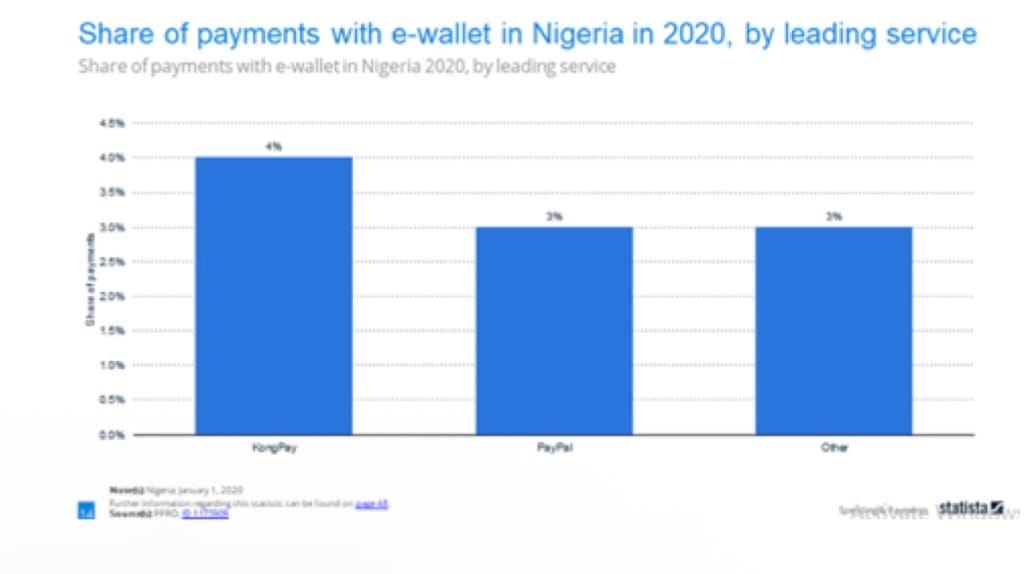
By January 2015, Konga was ranked the most visited website in Nigeria by Alexa Internet, highlighting its rapid consumer adoption compared to competitors in the region. Mid‑2015 saw the company acquire the assets and mobile money licence of Zinternet Nigeria Limited in order to launch KongaPay in August 2015, a payment solution designed to improve trust in digital transactions by integrating secure payment mechanisms tailored to local contexts.
In 2016, Konga expanded into logistics with KOS Logistics and same‑day delivery services, aiming to address persistent challenges in last‑mile fulfilment and delivery speed. Despite these operational investments, the company faced structural pressure in the e‑commerce market and was acquired by the Zinox Group in February 2018. Later that year, Konga was merged with Yudala, a retail enterprise with physical stores, creating what was then described as Africa’s first omnichannel retail‑tech platform, combining online marketplace strength with physical retail presence.
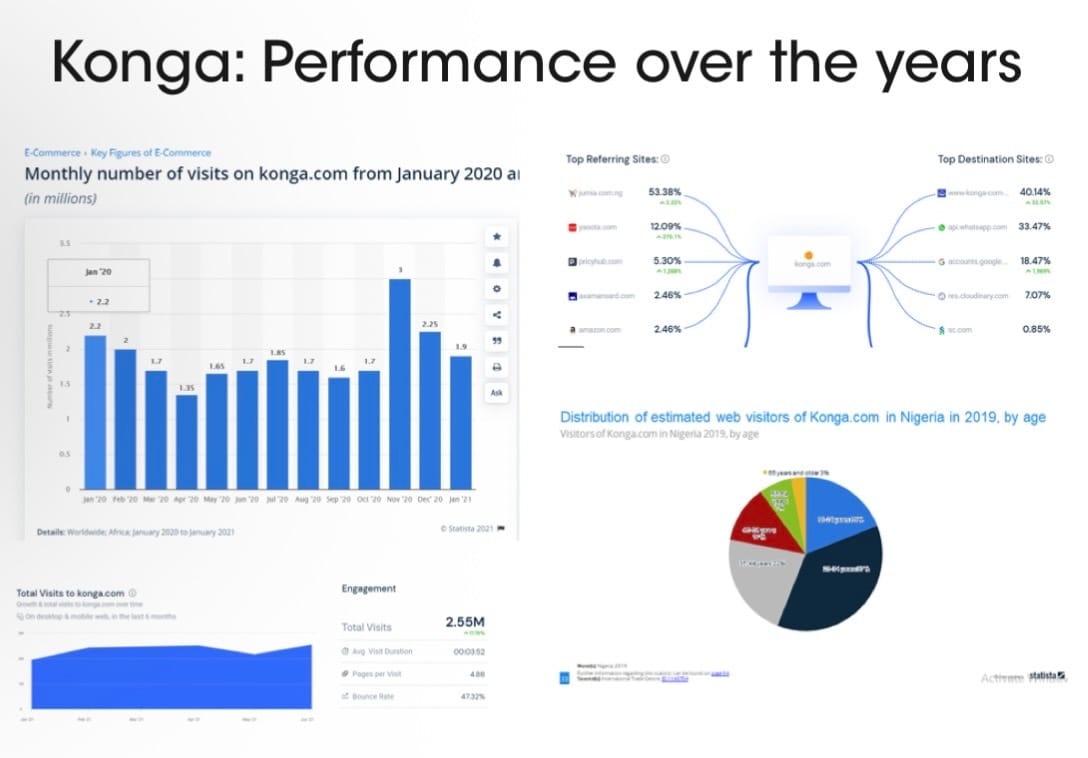
Post‑acquisition diversification continued with the launch of Konga Travel and Tours in March 2019, followed by Konga Health in June 2021, expanding services beyond retail into travel booking and health‑tech distribution. As of 2024, Konga’s ecosystem encompassed six major business verticals, over 200,000 registered merchants, more than three million monthly visits, and over 25 strategically located retail stores across Nigeria, reflecting ongoing growth in both digital and physical commerce channels.
Lessons for Other African Entrepreneurs
1. Mission Clarity Matters More Than Speed
Sim Shagaya has said that during Konga’s early growth phase, an intense focus on rapid customer acquisition sometimes overshadowed financial discipline. In hindsight, he believes building a smaller, slower‑growing business with solid gross margins and a strong customer experience would have been a more resilient strategy than sheer speed. He now prioritises profitability over unrestrained growth in his later ventures.
2. Build Around Real, Systemic Problems
Shagaya emphasises that founders should ask themselves Can I build this? But does this business need to be built? Products that solve structural challenges rather than nice‑to‑have convenience are more likely to occupy significant customer value in Africa’s markets.
3. Team Composition Is Critical
One lesson Shagaya repeatedly highlights is the importance of assembling the right team before scaling a business. He notes that identifying opportunities is only half the challenge; having people with the right skills and execution ability is what drives actual delivery.
4. Learn From Failure, Treat It as Data
Before Konga, Shagaya launched other ventures such as DealDey, which did not sustain long‑term success. Rather than discarding those experiences, he analysed why they failed including unit economics and market timing, and applied those lessons to Konga’s infrastructure‑heavy model. This view turns failure into actionable market intelligence.
5. Entrepreneurship Is Not About Money Alone
Shagaya has stated that his motivation in building companies is not the financial reward but the process of building systems that work and deliver value. This perspective shifts the focus from short‑term profit to long‑term impact, a mindset that can sustain founders through difficult phases of execution.
6. Resilience and Patience Are Non‑Negotiable
Operating in emerging markets like many African economies means frequent setbacks. Shagaya writes about the need for resilience and patience, emphasising that founders must often endure misunderstood strategies, economic downturns, and capital scarcity while remaining committed to their vision.
7. Strategic Partnerships Can Multiply Reach
Throughout Konga’s evolution, strategic relationships with investors like Kinnevik and local partners helped extend operational capabilities. Building relationships with trusted stakeholders including investors, suppliers, and ecosystem players provides founders with resources, negotiation leverage, and market reach that would be difficult to achieve independently.
8. Ground Products in Local Contexts
Shagaya has stressed that African markets differ widely from Western models. Localising product design, operations, and customer engagement understanding cultural nuances, payment behaviours, and logistical realities is essential for adoption at scale.
Konga’s journey under Sim Shagaya demonstrates that building successful digital businesses in Africa requires addressing structural challenges across logistics, payments, trust, and merchant access rather than relying solely on technology or market demand. The company’s milestones show how disciplined execution and systemic problem-solving create scalable impact. Looking forward, Konga’s model provides a blueprint for Pan-African commerce, suggesting that future ventures can succeed by combining operational depth with technology, local market insight, and infrastructure investment, paving the way for a more integrated, continent-wide digital economy.