Table of Contents
In the mid-20th century, British colonial planners envisioned a single university college for all of West Africa, to be located in Ibadan, Nigeria. Nigeria’s larger population, political influence, and central location made it the natural choice. Smaller colonies, including the Gold Coast (modern-day Ghana), were expected to rely on Nigeria to train administrators, scientists, and professionals.
Ghana’s leaders, however, recognized the risk. A nation preparing for self-government could not depend on another territory to educate its future leaders. Against prevailing colonial assumptions, the Gold Coast pursued its own university, treating higher education not as a luxury but as a foundation for state-building. Kwame Nkrumah’s words at the inauguration of the Gold Coast institution reflect this ambition:
“In spite of the humble conditions under which we have started, I bring you a message of hope and inspiration… I look forward to the time when there will be a chain of Ghana Colleges… leading to the founding of a very high institution in this country.”
Nearly eight decades later, Ghana’s foresight is evident. Universities in Accra, Cape Coast, and Kumasi now form one of West Africa’s most influential networks. The University of Cape Coast has consistently ranked as Ghana’s top university and leads the region in Times Higher Education rankings. The University of Ghana has also established a strong global brand. What was once expected to orbit Nigerian academia now leads it.
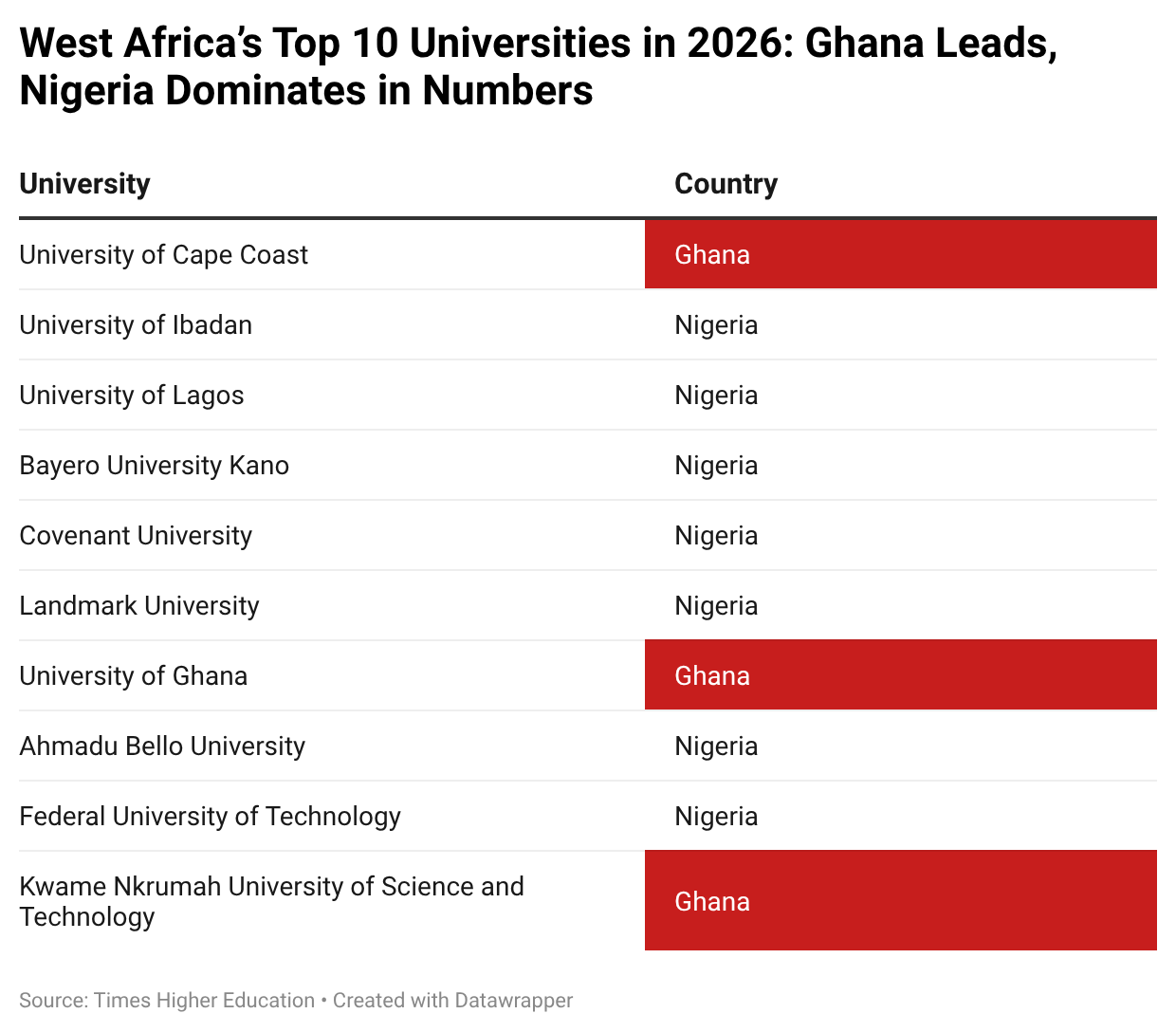
Why does Ghana’s University of Cape Coast lead Nigeria’s top universities?
Ghana’s success stems from strategic focus, stable governance, and investment in research. The University of Cape Coast leads West Africa in the 2026 Times Higher Education African rankings, placing 12th continent-wide. Its strength lies in research output, faculty development, and regional collaboration. Initiatives like the West African Centre for Crop Improvement attract doctoral students across Africa, driving agricultural innovation that benefits thousands of farmers. The Radio Astronomy Observatory connects Ghanaian researchers to global scientific networks, enhancing visibility and impact.
Nigeria, by contrast, has a larger higher-education system. More of its universities appear in the Times Higher Education global listings, including the University of Ibadan and the University of Lagos, and the country enrolls significantly more students. Yet this numerical advantage has not translated into top continental positions. Rapid expansion strained resources, leaving some faculties under-equipped and research output uneven. Administrative instability and frequent strikes further disrupted progress, making it difficult to maintain consistent standards. The President of the Academic Staff Union of Universities (ASUU), Nigeria’s main university lecturers’ union, bluntly highlighted this challenge:
“We can’t be calling ourselves the giant of Africa, and we are the worst in education…students from Nigeria going to Ghana…”
Leadership and governance were decisive. Ghanaian universities maintained stable management structures, enabling long-term planning, faculty retention, and the growth of high-performing academics, including PhDs returning from abroad. Nigeria struggled to retain talent, creating gaps in research capacity and teaching quality.
Economic conditions also influenced institutional choices. In the 1970s and 1980s, Ghana faced severe financial strain, including hyperinflation and reduced public funding. With limited resources, universities concentrated on protecting core programs and maintaining academic standards rather than expanding rapidly. This period reinforced a culture of selectivity and focus.
Nigeria, buoyed at times by oil revenue, pursued expansion, establishing new universities and increasing enrollment even during economic volatility. While this widened access, it also stretched funding, infrastructure, and faculty capacity. Over time, the contrast between consolidation and expansion shaped the performance gap visible today.
The result shows how Ghana now boasts four universities in Africa’s top rankings, each contributing to a cohesive, high-performing system. Nigeria, while larger, has fewer top-tier performers. Programs in agriculture, crop improvement, and science make Ghanaian universities regionally influential, attracting students from across West Africa.
What lessons does Ghana’s top-ranking universities’ success offer to the region?
Ghana’s experience shows that smaller nations can outperform larger neighbors when strategic vision guides higher education. One critical lesson is the importance of a focused strategy. Concentrated investment in programs that align with national and regional needs produces tangible results. For Ghana, initiatives like crop improvement, scientific innovation, and research networks have created impact far beyond the classroom, reinforcing both academic and national leadership.
Another lesson is the value of stable governance. Consistent administrative structures allowed Ghanaian universities to plan long-term, maintain quality, and retain faculty. Stability fosters institutional memory and ensures policies and programs are sustained, even in times of economic or political stress.
Talent development also emerges as a cornerstone. By nurturing academics, supporting PhDs returning from abroad, and providing opportunities for professional growth, Ghana strengthened its research capacity and teaching quality. The result is a system that attracts top talent regionally and internationally, further enhancing visibility and influence.
Finally, Ghana demonstrates that measured growth outperforms unchecked expansion. While Nigeria focused on scale, Ghana concentrated on core programs and strategic priorities. This deliberate approach preserved quality, reinforced institutional culture, and allowed the universities to compete at a global level, rather than merely expanding numbers.
The takeaway is clear. It clearly shows how academic leadership is built by design and strategy. Ghana’s universities demonstrate that stability, focus, and alignment with core goals can create institutions that not only excel nationally but also lead regionally and influence Africa’s future.