Table of Contents
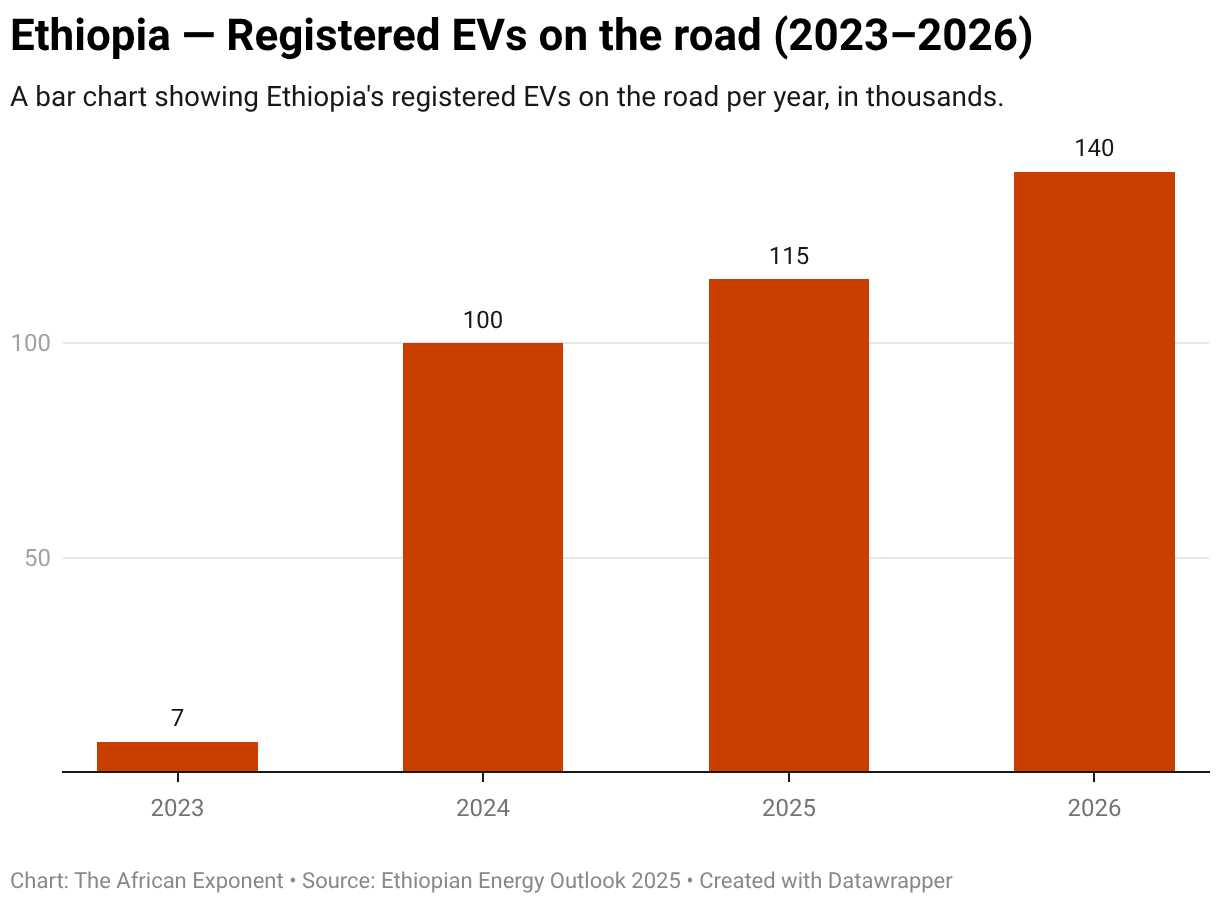
Ethiopia is running an unusual mobility transition. It is pushing electric vehicles before it has built a fully developed electric car market. The number of EVs has jumped from about 7,000 in 2023 to well over 115,000 by early 2026. Some officials put the figure closer to 140,000 by mid-2026. This growth carries major economic value for the country. Ethiopia spent about USD 4 billion on fossil-fuel imports in 2023, so every EV that replaces a petrol or diesel vehicle helps preserve scarce foreign exchange.
Government policy rather than consumer preference has driven this transition. Ethiopia became the first country in the world to ban import of internal combustion engine (ICE) vehicles in January 2024 through customs and foreign-exchange controls. It expanded the restrictions to ICE vehicle kits in May 2025 and petrol and diesel trucks in October 2025. In December 2024, the Electric Vehicle Charging System Directive required importers and assemblers to install charging stations. In May 2026, the Ministry of Transport and Logistics launched the National E-Mobility Strategy 2025–2030 in collaboration with UNECA, ITDP, and WRI. This brought charging and fleet-electrification targets under one roadmap.
Tax incentives have reinforced the policy push since 2022. VAT, excise, and surtax exemptions, alongside lower customs duties have made EVs more affordable than ICE vehicles. The advantage remains despite the return of a 15% VAT on EVs in August 2024, as customs duty fell to 5%.
These measures have created EV demand driven primarily by policy. Buyers still have limited vehicle choices but the direction is clear: Ethiopia is closing the door on ICE vehicles and steering its transport market toward electric alternatives.
Can the grid and charging network keep up?
Ethiopia has set ambitious charging targets. By 2030, the Ministry of Transport and Logistics plans 1,176 charging centres in Addis Ababa and 1,054 in regional cities to achieve a target of more than 2,200 charging stations nationwide. The strategy also calls for fast chargers every 50 kilometres on major routes and heavy-duty chargers every 120 kilometres per the IEA's Global EV Policy Explorer. This approach treats charging as essential national infrastructure, not simply a retail service.
Charging station roll out has accelerated, but the gap remains wide. According to a report by Addis Fortune, Ethiopia had only about 46 operational charging stations nationwide in mid-2024. By late 2025, Addis Ababa had more than 100 public stations, while importers and assemblers had installed over 460 charging points. By mid-2026, officials estimated that the capital city had around 200 completed stations, which is strong progress, but still far below the city’s target of 1,176. Regional cities remain further behind.
Grid readiness remains the main constraint. Ethiopia’s hydropower-heavy system gives EVs a low-carbon advantage, and the 5,150 MW Grand Ethiopian Renaissance Dam has improved electricity supply. However, drought risk, weak transmission and distribution networks, and regular urban outages could limit the expansion of high-speed charging.
Charging operators will need to plan around grid capacity, not just location and customer demand. High-use sites may require dedicated power connections, while smart-charging systems will need to manage demand during periods of grid stress. Investors who overlook these constraints could see costs rise and service reliability fall especially during dry seasons when the grid is unreliable.
Is the bigger commercial opportunity in vehicle imports or in fleet conversion and services?
The structure of the Ethiopian EV market is changing quickly. More than 250 registered importers are competing for a still-limited customer base, which is putting pressure on margins. At the same time, Ethiopia wants EVs to rise from more than 60% of new vehicle registrations in 2024 to 80% by 2030, which will expand demand not just for vehicles, but also for charging, maintenance, financing, and battery end-of-life services. Importers that miss these added revenue streams will end up selling vehicles as a low-margin commodity.
That transition makes fleet conversion the stronger commercial play. Taxis, ride-hailing cars, delivery vehicles, buses, and two- and three-wheelers operate far more intensively than private cars, so the payback period on electrification is shorter and the financing case is cleaner. Fleet operators also need practical support ranging from vehicle finance, leasing, battery-as-a-service, and reliable maintenance networks. These services still do not exist at scale in Ethiopia, which leaves room for businesses that want recurring revenue instead of one-time sales.
Maintenance is particularly under-served. EV drivetrains require different skills, diagnostic tools, and spare-parts supply chains than ICE vehicles, and Ethiopia's existing garage network is built around the latter. Battery-related services, including cell balancing, second-life applications, recycling logistics, remain largely undeveloped. The first movers to build technical training pipelines and standardised service protocols will lock in network effects before consumer volume forces consolidation. Technical colleges and vocational programmes are an underpriced entry point for operators willing to invest in human capital early.
Fleet conversion is not only where volume is heading; it is also where the economics make sense first. Investors who wait for the consumer market to mature may find that the most valuable service layers are already taken.
What should investors and operators back and what should they avoid?
The strongest opportunities sit in infrastructure and services, not in vehicle imports alone. Import-only models look weaker because margins will likely keep tightening, while demand is expanding for charging, fleet finance, maintenance, battery services, and commercial-vehicle electrification. Investors should focus on B2B customers such as logistics firms, ride-hailing platforms, and municipal bus operators, where high vehicle use can support premium service contracts and multi-year revenue streams.
Charging operators should start in Addis Ababa’s busiest corridors since existing stations and charging points already show clear demand. Then they can expand into regional capitals and major highways as national coverage targets take effect. Co-investing with utility partners on dedicated power lines, and adding on-site solar and storage at key hubs, can reduce outage risk and improve cost control.
The risks are just as clear. The ICE ban created real disruption in transport and agriculture. Addis Fortune reported logistics and agricultural-sector disruption as operators adjusted, with tractors and trucks stranded at Djibouti ports until the Ethiopian Investment Commission intervened. Policy rollout will likely remain uneven. Investors should test grid capacity assumptions against dry-season conditions, not average-year projections, and they should avoid treating Ethiopia as a single homogeneous market opportunity. Addis Ababa, regional cities, and highway corridors each need different business models, financing structures, and partnerships.
The entry window for infrastructure-led players will not stay open for long. Ethiopia’s EV fleet has already expanded sharply since 2023, and each new vehicle increases demand for chargers, technicians, and finance. Operators that move early can shape service standards and lock in the economics that later entrants will have to live with.